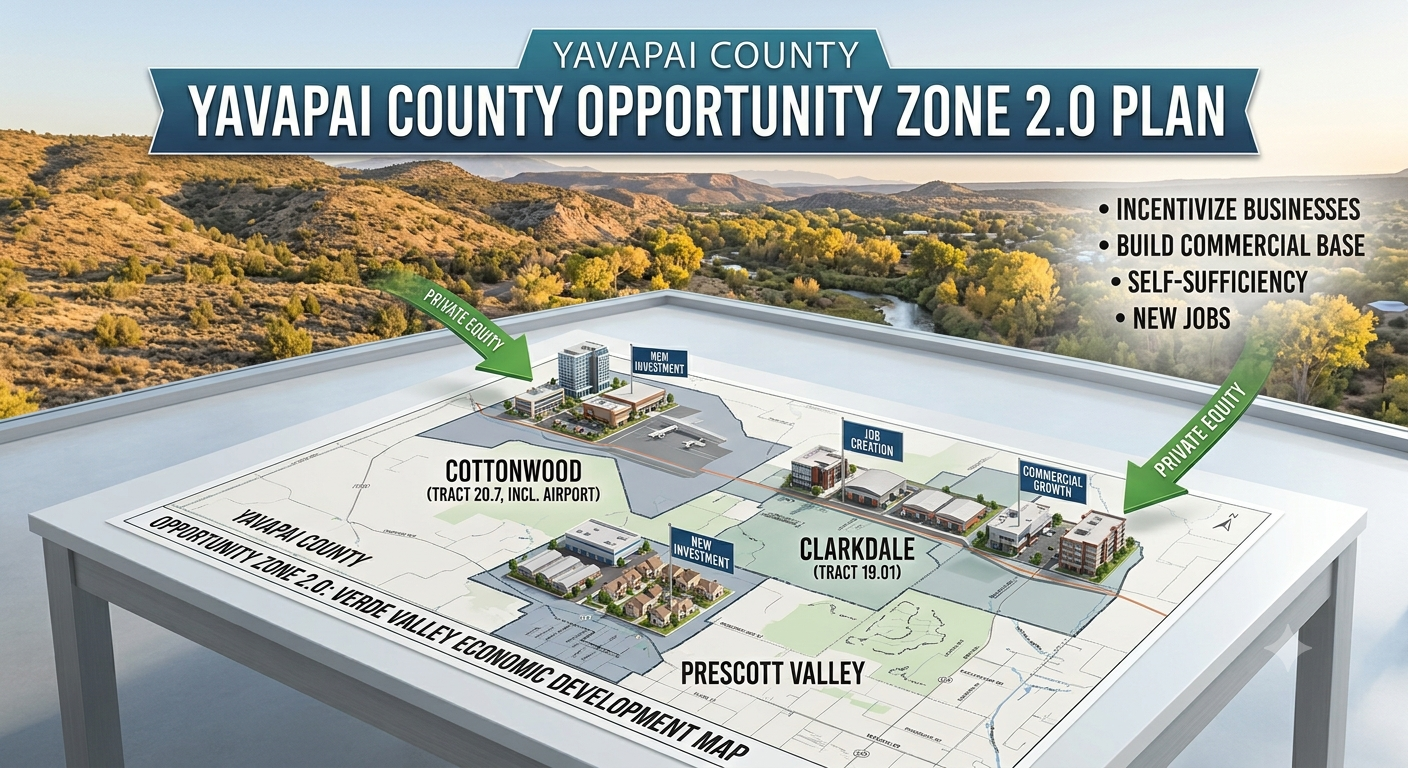
The Yavapai County Board of Supervisors voted 4-1 on June 17 to follow a recommendation from Yavapai County Free Library District Director Corey Christians and ask the Arizona Commerce Authority to include census tracts in Cottonwood, Clarkdale and Prescott Valley in the federal Opportunity Zone 2.0 economic development program. The vote occurred during the board’s meeting in Cottonwood.
“I’m ecstatic,” Clarkdale Mayor Robyn Prud’homme-Bauer said. “This is a good opportunity for us to incentivize businesses to come to Clarkdale and build some commercial along our corridors that are already commercially zoned. We have to build our economic base in Clarkdale and become more self-sufficient by being able to have more sales tax revenue, hopefully jobs that are of a decent wage.”
Thirteen census tracts in Yavapai County were determined are eligible for the program but the county is permitted to recommend only three to the state. Supervisor Chris Kuknyo [R-District 4] cast the opposing vote and pushed for the board to have Chino Valley, which he represents, as being among the three. The board also decided to support adding Chino Valley to the program, if an opportunity to do so presents itself.
The Opportunity Zone program seeks to incentive private equity to spur economic development in the United States.
“Let’s say you just had a big investment, you sold a building, made $10 million off it, [but] you don’t want to pay the capital gains on that $10 million, [so] you can put it into a qualifying Opportunity Zone fund,” Christians said. “Once that happens, if you keep your money in that fund for five years.”
Then, you have a 10% deferral of capital gains you don’t have to pay, and 30% in rural areas, he said. If it’s in the fund for 10 years, you don’t have to pay any capital gains on the initial money invested.
Originally established through the Tax Cuts and Jobs Act of 2017, the Opportunity Zone program through preferential capital gains tax treatment incentives private investment in economically distressed communities, and was reauthorized through the Big Beautiful Bill Act in 2025, and new zones are to be designated every 10 years.
The Arizona Commerce Authority outlined the eligibility requirements for OZ designation: “The tract has a median family income that does not exceed 70% of the state’s median family income — if in a non-metro area — or 70% of its metropolitan statistical area’s median family income if the tract is in an MSA. … That the tract has a poverty rate of at least 20% and a median family income that does not exceed 125% of the state’s median family income if in a non-metro area or 125% of the metropolitan area’s median family income if the tract is in a metro area.”
Clarkdale
Clarkdale’s recommended tract is Census Tract 19.01, GEOID 04025001901, and is 100% of the property that fits existing zoning can be built on without further approvals.
The town’s application cited town-owned land with interested developers, the Belle Maison subdivision, the Cobblestone Hotel and the Plateau subdivision as activity within the tract, and noted Clarkdale is working with the firm Retail Strategies to develop the State Route 89A commercial corridor that anchors the zone.
Cottonwood
The recommended zone for Cottonwood is Census Tract 04025002007 [20.7], that marginally crosses into Clarkdale’s jurisdiction. The tract includes the Cottonwood Airport.
“The area around the airport, we would love to have some warehousing and some larger industrial developments,” City Manger Mario Cifuentez II said. “It’s zoned appropriately. We have a lot of things ready for shovel-ready projects. We have plenty of property there. The tie-in with the airport adds some added benefit, and anything that we can get there, and any investment that we get there will result in higher paying jobs.”
“Spring Creek Ranch; Niblack Verde Plaza; Bill Springs, 250 units; Wescott/Marty Hall, 92 units; Clemenceau East, 18 Units; Westates, 2 separate subdivisions with 200-plus units in each; Vineyards 4&5, 550-plus units; 89 & Vine, 1,750 units,” Cottonwood Director of Strategic Initiatives Ryan Bigelow cited as major projects in the city pending or under consideration.
Camp Verde
The 1.0 Opportunity Zones which included nearly the entire boundary of the Town of Camp Verde, and after being in effect for 10-years, will sunset in 2028.
“Unfortunately, the census tract that previously qualified within Camp Verde is no longer eligible for designation,” the Camp Verde Town Council packet for June 10 reads. “Town staff learned that the tract no longer meets the federal criteria for a low-income census tract and therefore does not satisfy the economic distress thresholds required for eligibility. These thresholds are based on factors such as poverty rates, median household income, and other demographic indicators.”
Town Manager Miranda Fisher said she believes the loss of eligibility is related to population growth, increasing property values and household income increasing in the town. Additionally, there is no appealing the eligibility determination, however investments made prior to the end of 2027 when the 1.0 program sunsets will still qualify for the benefits.
“FrameTec and High View … that was the biggest area where the Opportunity Zone covered, actually a large portion of SR 260 — Sycamore Vista benefited,” Fisher said. “We saw some good development come forward with the Opportunity Zone.”
Camp Verde did not qualify for Opportunity Zone 2.0 in large part because water, power and sewer availability are major requirements under the new program. Fisher said the lack of sewer service along SR 260 was likely what stalled the town under Opportunity Zone 1.0 as well.
“It’s a transition for us to lose this opportunity zone,” Fisher said. “We’ll still keep working hard to develop the area and keep going on our sewer on 260 because that was always the barrier, and then you know, in 10 years, when we get to 3.0, we’ll try to submit again.”