Board modifies call to the public restrictions; allows ESA in sports with $2K fee
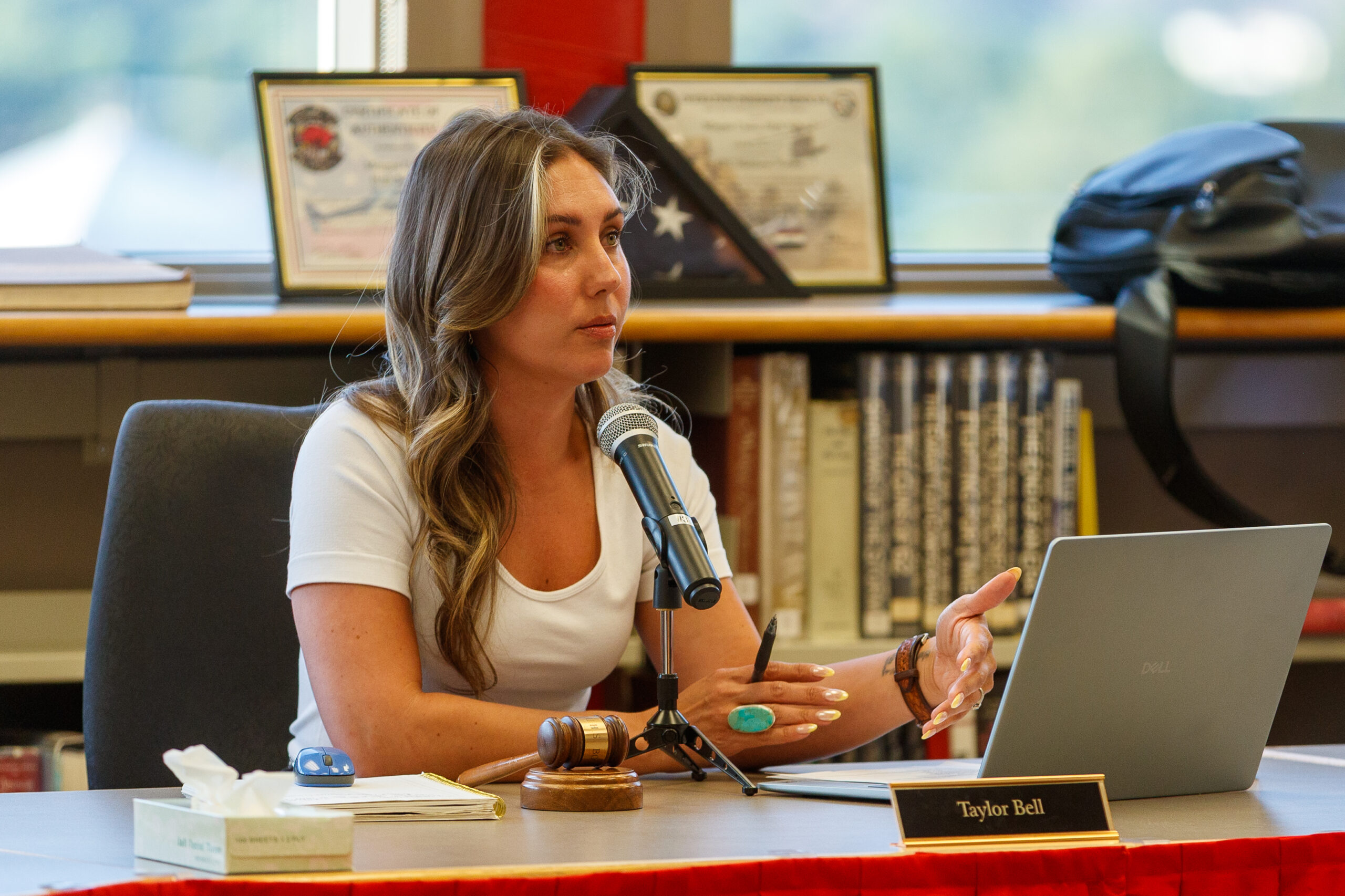
When Mingus Union High School Governing Board Member Will David asked who wrote the policy to allow board member’s spouses to volunteer in the school district, Board President Taylor Bell said it was artificial intelligence, which she said the board has used for a while to draft policy.
Bell said she and Superintendent Melody Herne, Ph.D., have discussed it in one-on-one meetings in the past.
“There’s nothing written that says that it cannot take place,” Bell said. “However, in order to do things in a legitimate and cautious way, it’s better to have one, so that if that occurs, there aren’t any issues that arrive afterwards.”
Arizona state law forbids board members’ spouses to be employed by their district. The statute does not mention volunteering.
The policy is directed at volunteer roles, like coaches, and not onetime volunteering, likea mother bringing her child’s classroom bread, which board member Austin Babcock said his wife does on occasion.
“When we have volunteers come on board, they go through the application process, the IBP, the background check,” Herne said. “They are considered employees, meaning they … follow all of the policies that we have in place, they got the chain of command that they go through and, again to what board member David said, I would be their boss.”
Bell said the district benefits, not the family member, because they’re the one giving time and energy to the district.
“If you read this, then you would read that there is a prohibition of employment on this policy that says that the spouse being allowed to volunteer does not in any way or fashion promote or support that spouse then being employed,” Bell said.
David said the conflict of interest remains, because benefits go beyond finances. Those with “a dog in the race” should recuse themselves from voting on the policy, he said.
“I’ve interviewed hundreds of prospective folks for jobs, and in that process, oftentimes volunteerism is cited as a main factor in their job application,” David said. “It’s interesting, because people volunteer to do a lot of things to get the bona fides to apply for future jobs, so there is an angle to this that is dangerous.”
David said seeing it on the agenda was the first time he heard about it.
“I actually go to these board conferences where I sit with rural district board members for hours, and when I raise this, they all raised their eyebrows. ‘Why are you going that route?’” David said.
The Arizona School Boards Association summer leadership conference in Flagstaff from June 4 to 6 and was attended by board members David and Rev. Frank Nevarez.
“Off of their lips came the word ‘recuse’ several times,” David said. “So yes, small districts like Young [Public School District] — 53 students out there in the middle of nowhere, east of Payson — it absolutely relies on volunteers and has challenges. Even they said, ‘we’re not keen on board members, spouses volunteering in our very, very small district.’”
The board voted 2-2 on the policy, with David and Babcock opposed.
Babcock said he could support it if legal counsel OKs it, which Bell requested be added to a future agenda.
Call to the Public
At all future regular board meetings, calls to the public will shift depending on the number of people: No changes if there are 10 or fewer requests to speak, each will continue to have three minutes with up to 30 minutes of comment.
With 11 to 15 speakers, there will be a two-minute limit with a cap at 30 minutes total. If there are more than 16 speakers, each will get one minute and the call to the public will be capped at one hour.
Bell said she doesn’t want to use recent examples to change protocol.
“I think we need to … look at this as ‘what do we want to see across the board in every meeting,’” she said. “[I] just don’t want to get into any sort of open meeting law violations, but … there needs to be several different votes that take place related to this.”
While board member Matt Chavez was absent, the rest of the board votedto approve these changes along with moving the call to the public to the end of the meeting and removing the requirement of stating an address, as long as the written form includes the address.
“I know we don’t want to use recent examples, but if we had merely extended some by a few more speakers, we might have helped to deflate a whole lot of resistance to the board not being willing to listen to people,” David said. “So we need to have a mechanism in place where we signal to the public that it’s important that you, in fact, can come and speak.”
The board also discussed removing calls to the public from monthly work sessions entirely, because David said those meetings are already constrained to two hours.
Herne said removing it from the work sessions doesn’t require a vote, because a call to the public is not legally required.
She and the president can leave if off the agenda.
ESA Students
After a 3-1 vote, with David against, the board voted to approve allowing students using Empowered Scholarship Accounts to play sports at MUHS.
The following vote required those students to pay a $2,000 fee per sport to participate; it passed 31 with Bell opposed. Bell later said the $2,000 fee was too high.
“The national average is $50 to $200 per sport, with a cap of $100 to $500,” she said. “$2,000 per sport, I think we might as well just remove the vote that we just put in place, because I don’t know any family” that could afford it.
The policy was first discussed in August to allow the students to compete at the $2,000 per sport rate, which is based on Mesa Public School’s approach.
David said $2,000 sounds great for a student who otherwise would give MUHS nothing, but he would argue differently.
“Imagine if they were at Mingus, [we] would actually get $11,00 to $12,000 for the annual amount of money that we get for ADM per student, depending on their particular status,” he said.