Cottonwood City Council will talk cameras’ future at work session Sept. 22
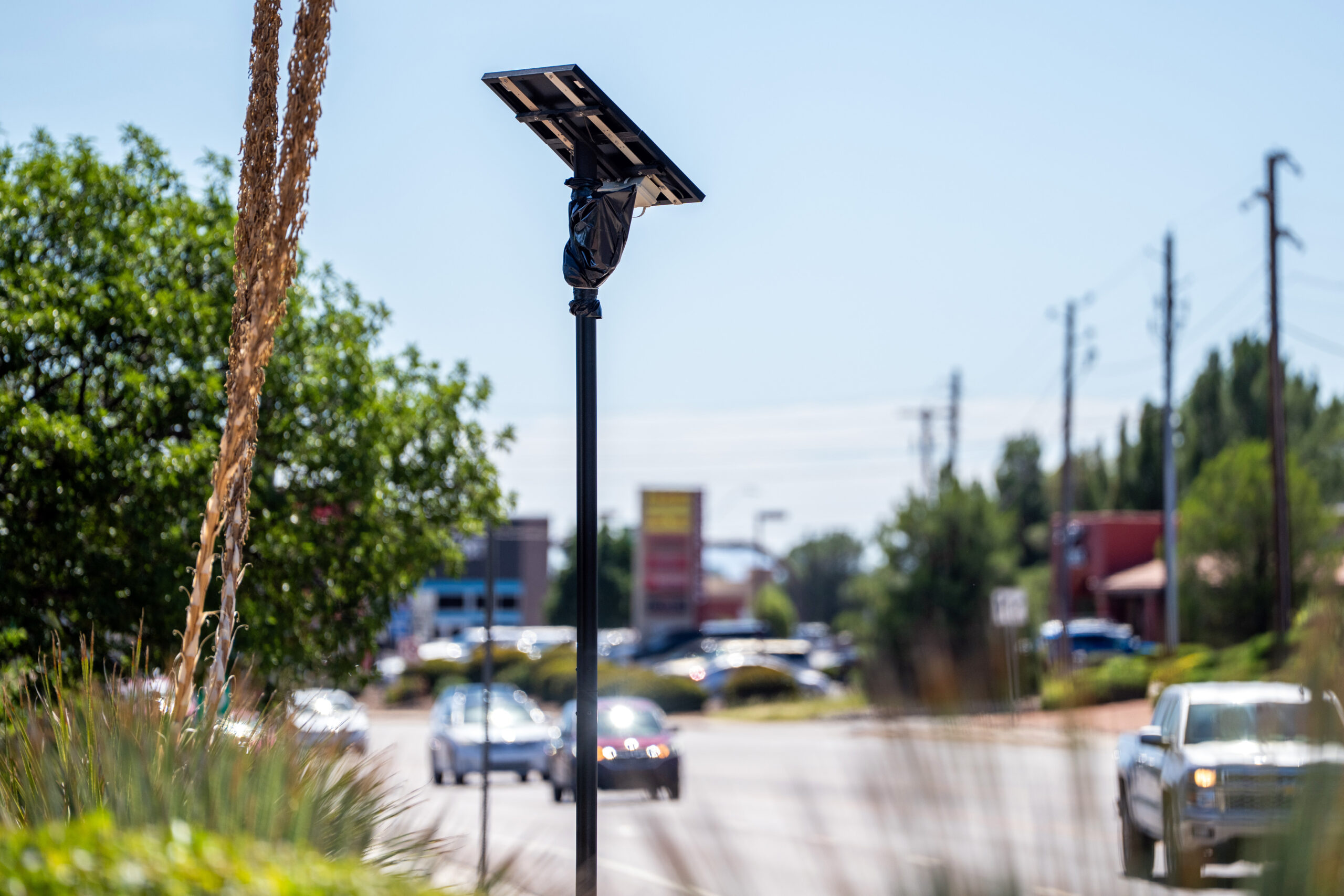
The city of Cottonwood and Cottonwood Police Department announced Friday, Sept. 4, that they shut off its network of Flock Safety Inc. automated license plate readers and later covered them in black plastic bags.
Cottonwood City Council will hold a work session on Flock cameras on Sept. 22, at the Riverfront Council Chambers. By statute, no action will be taken and residents are not permitted to speak, but they are invited to attend.
Following discussions between Cottonwood City Manager Mario Cifuentez II and Chief of Police Brian Freudenthal “regarding the level of discord the license plate reader issue is generating within our community, it has been determined that it would be best to suspend the use of this technology at this time,” the Sept. 4 announcement reads.
“Just bring an open mind, we’re committed to community and public trust, and without it, our job is more difficult,” Freudenthal said. “So, if the public and the community is at a point where they’re done with Flock and they don’t think it’s the right tool for us, then we’ll listen.”
Flock Searches
From Jan. 1 to July 24, 2026, CPD ran 4,335 Flock searches. About 70% were within Cottonwood’s own network, but 1,288 went beyond it, including 452 that each searched roughly 6,000 other networks — according to the CPD’s audit logs provided to Larson Newspapers by Fight the Flock Cottonwood.
Across the local Flock searches, run by CPD, 3,220, or 74.3%, had a case number entered, though 147 of those entries were placeholders such as “NONE” or “TEST” rather than an actual case number. Written narratives explaining the reason for the search were included in 1,572 searches, or 36.3%. Only 1,094 searches had both a case number and a narrative, an “all fields filled” rate of 25.2%. Another 637 searches, or 14.7%, had neither; beyond the required “crime” category, they carried no case number and no explanation.
Regarding CPD’s compliance numbers, Freudenthal said, “The spreadsheet doesn’t give you the context,” and cited the previously reported 46 consecutive domestic assault searches CPD ran in the Coconino County Sheriff’s Office Flock network between 10:48 and 11:15 a.m. on April 1 that had no case number. CPD’s own log shows a case number was in use during that search, while the 46 searches that reached outside networks, including CCSO’s, had none.
“The context behind that was a female in a parking lot that screamed, called the police as she was getting forced into that vehicle,” Freudenthal said. “The officers desperately were trying to find that vehicle as fast as they could.”
The total 4,335 searches breakdown:
Traffic infractions accounted for the largest volume with 826 searches, followed by hit-and-run or car accidents at 363, and domestic assault or battery at 358. Welfare checks and weapons offenses involving guns or shots fired each accounted for 274 searches, closely followed by drugs or narcotics at 260, larceny or theft at 221, motor vehicle theft or stolen vehicles at 216, and non-domestic assault or battery at 215.
Fewer searches were recorded for burglary or breaking and entering at 168, missing or endangered persons and runaways at 158, wanted persons with arrest warrants or fugitives at 127, DUI at 109, sex offenses at 99, threats or harassment at 92, and disorderly conduct or disturbances at 91.
The remaining inquiries targeted criminal motor vehicle offenses such as road rage or reckless driving at 74, stolen property at 72, trespass at 62, vandalism or property damage at 56, robbery at 49, kidnapping or abduction at 44, and 127 searches in other, smaller categories, such as protective orders.
None of the 4,335 searches cited human trafficking.
Outside Agencies
The Yavapai County Sheriff’s Office was cited in 61 searches, led by 32 for domestic assault or battery. This included a Feb. 24 search for a white Chevrolet sedan fleeing a domestic violence incident. The remainder included 18 welfare checks, highlighted by a series of three consecutive lookups on Feb. 23 for a vehicle with an unknown plate, six searches for property destruction, four for sex offenses and one for a missing person.
The Sedona Police Department was cited in 28 searches, including 20 for robbery assistance and eight for larceny or theft. The robbery occurred during a concentrated block of searches on April 14, when officers ran multiple lookups for a black Mercedes sedan without attaching a local case number.
The Camp Verde Marshal’s Office was cited in 26 searches, consisting of 20 traffic infractions and six stolen vehicle lookups. The vehicle theft tracking included an April 12 inquiry for a stolen motorcycle with an unknown plate.
“We do not have any Flock contracts,” YCSO Cmdr. Brent Kimbriel said during a Yavapai County Open House in the Verde Villages on Sept. 3. YCSO does have a memorandum of understanding with Flock — that the Board of Supervisors approved during its Nov. 2, 2022 meeting — allowing YCSO to search outside agencies’ Flock networks.
“We had some ALPR and some other software contracts come to the board of supervisors, and we did deny those, not out of principle or understanding that there’s use for them, but just that we really needed to understand the policies that were working behind those contracts,” Yavapai County Board of Supervisors Vice Chairwoman Nikki Check [D-District 3] said at the open house.
The board unanimously denied three Ekin Patrol mobile ALPRs, and $13,847 contract with LeadsOnline LLC for a NightHawk Subscription Services Agreement at its Aug. 19 meeting.