After public pushback, City Council places ALPRs on a future agenda
After several residents spoke at the Aug. 4 Cottonwood City Council meeting about Flock Safety cameras in the city, council voted unanimously to add a discussion to a future meeting.
The motion, brought by Vice Mayor Felicia Coates, included “an opportunity for the community to learn more about the Flock system, how all the data is retained, safeguards and some of the other issues.”
Seven people spoke against the Automated License Plate Readers, and three submitted cards to support those speaking, but did not speak. About 15 people in the audience stood in support while people spoke against the use of Flock mass surveillance.
Councilmen Chris Dowell and Bob Marks were absent. Dowell is a former Cottonwood police chief and Sedona deputy chief, who had been tasked to manage the SPD’s Flock camera system. Pushed by Sedona Mayor Scott Jablow, Sedona’s cameras were installed in June 2025 without public notice but never went live due to residents’ opposition.
Sedona City Council ultimately canceled the Flock contract and remove the 11 cameras in September. Jablow later resigned.
The Indivisible Cottonwood Clarkdale Cornville organization urged residents to push against the cameras, and held its third meeting on ALPRs on Aug. 1.
Organizers Lori Pedersen and Sandy Boyce discussed ways to remove them, like speaking to council members in and out of meetings, drafting letters to local media — which can be sent to editor@larsonnewspapers.com — and setting up events and discussion posts on social media. Boyce said the goal is to persuade the Cottonwood council to remove the ALPRs, similar to Sedona in 2025.
Cameras
Shortly before Larson Newspapers broke the news about Sedona’s ALPRs last June, the Cottonwood City Council approved a contract with Flock providing eight additional cameras and two drones to the Cottonwood Police Department on June 17. The decision was made on the consent agenda, with an abstention by Dowell.
Four Flock ALPRs were installed in 2021, after CPD approved an $11,000 contract with the surveillance company. By the 2025 vote, there were 11 ALPRs installed around the city, but because the cost was in CPD’s budget and below the threshold requiring a council decision, they were not publicly voted on. As of Aug. 4, there are 11 ALPRs around Cottonwood. A map can be found on deflock.org.
“These systems were funded through grants from the Arizona Department of Homeland Security and Arizona Automobile Theft Authority,” CPD Cmdr. Gareth Braxton-Johnson said in a statement following the 2025 decision. He said the data generated by Flock cameras are governed by the Arizona State Library Archives and Public Records Retention Schedule, and are available for the public to request.
Human Trafficking Grant
The 2025 Flock agreement came before council instead of being an internal CPD decision because it cost $199,000, a larger agreement than previous ones, and included a $213,992.80 grant acceptance from the Arizona Department of Public Safety to “enhance law enforcement services and programs that reduce human trafficking within the state,” the funding agreement reads.
“Traffickers have increasingly leveraged social media, encrypted messaging apps, and cryptocurrencies to recruit victims and avoid detection,” Braxton-Johnson wrote in 2025.
By the time the decision was approved by council, Braxton-Johnson said there had been human trafficking cases initiated by or referred to CPD, including four in 2020, five in 2021, seven in 2022, 19 in 2023, eight in 2024 and nine in the first half of 2025.
The 2025 decision was for a two-drone and eight-camera package with Flock, not an ALPR agreement. The cameras in question were “Community Partnership Cameras.”
“The recent proposal was publicly noticed and placed on the agenda for the June 17 City Council meeting,” he wrote after the 2025 decision. “This process allows for public comment or council discussion. During the meeting, no concerns regarding constitutional rights or other issues were raised. It is also important to note that similar camera systems have been in place in Cottonwood for approximately five years.”
The proposal was not pulled off consent for public discussion.
Live-feed Community Partnership Cameras are operated by CPD but placed on private business property open to the public, like gas stations and convenience stores, and they usually have a green or blue light meant to draw attention and deter crime. While not ALPRs, according to the meeting’s packet, CPD added software to its contract that allows for searches of vehicles and descriptions with AI assistance.
“The camera feed go straight to your local police department and are meant to be viewed for situational awareness for responding officers,” Flock’s website reads. “Investigators can access recorded footage for official law enforcement purposes. All access is logged and will be in accordance with your police department’s policy, laws and regulations.”
As of Wednesday, Aug. 5, Braxton-Johnson said the community partnership cameras had not been installed. When asked about whether the cameras use facial recognition technology in its software, he said they do not.
Public Pushback
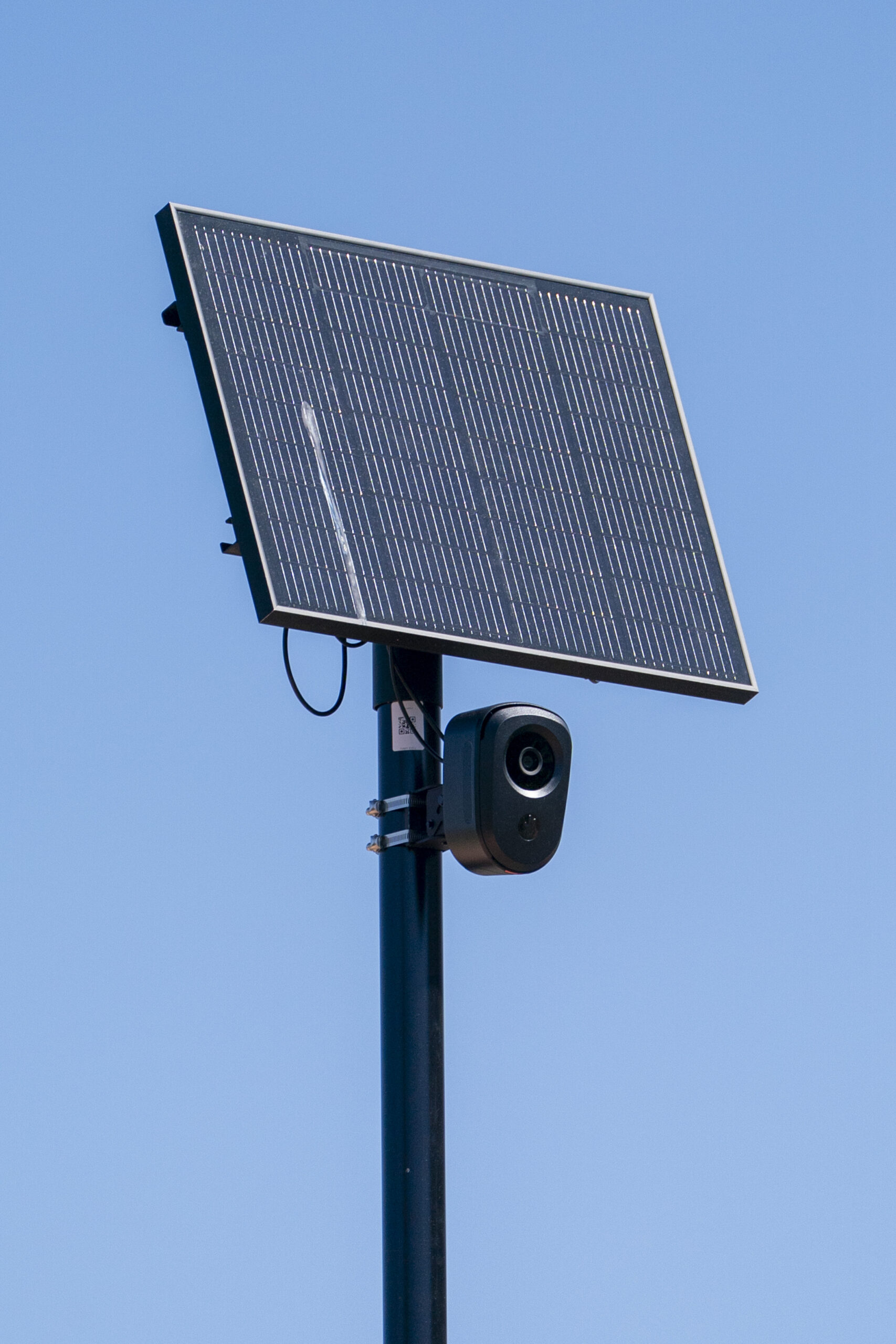
After the news broke on Sedona’s ALPRs, Cottonwood residents noticed the Flock cameras with solar panels on top.
“People put two and two together here,” Pedersen said, “Like I said, I drove by these things all the time, didn’t think anything of it.”
Flock has also made headlines across the state and country, as cities like Flagstaff and Sedona revoked their contracts. Recent national news regarding Flock includes pushback after record requests showed Flock Vice President Bob Carter viewed the inside of a girls gymnastics practice multiple times to pitch the product.
“With these Flock Safety cameras, … we don’t know what’s happening with our data,” Cottonwood resident Zachary Jablow said during public comment. “Other people can access our data. These cameras can get hacked.”
Even without publicly accessible information about how the data is retained and used, others at the meeting raised concerns about the technology’s surveillance aspect.
“This technology collects massive amounts of information on law abiding citizens,” Cottonwood resident Pam Wilson said during public comment on Aug. 4. “The community deserves an opportunity to understand how it works, what data is collected, who has access to it, how long the data is retained and what safeguards are in place to prevent misuse.”