
Cottonwood City Council hears study on workforce versus affordable housing
The Cottonwood City Council signed an agreement with Housing Solutions of Northern Arizona during its Aug. 4 meeting to move forward with a workforce housing project converting long-term hotel rooms along Cove Parkway.
The agreement, which was approved 5-0 — with Councilmen Chris Dowell and Bob Marks absent — includes placing restrictions on renters’ incomes to 80% and 100% ofthe Average Median Income.
The AMI in Cottonwood is $48,448 annually, according to a study by Elliott D. Pollack & Company, a consulting firm. Yavapai County overall is $87,300. The agreement would also bar any use as short-term rentals and give a preference to city employees.
“It’ll help us as a recruitment tool,” Cottonwood Director of Strategic Initiatives Ryan Bigelow said. “If we have some folks who can’t get here because they can’t find a place to live, we get to hop in the front of the line.”
While the Flagstaff-based nonprofithas raised the funds for the majority of this project, the total costs exceed what it can pay up front. It proposed a gap financing agreement, which would act as a loan for the organization to pay back in time.
“We are not agreeing to exactly how we’re going to do gap financing, but we will do a concessionary interest rate, low downpayment [and] deferred repayment schedule to help with that part,” Bigelow said. “So again, that’s the gap financing part. We will find out the details and come back to youin September.”
The project went before the Planning & Zoning Commission on Monday, Aug. 17, after press time, and it will go again before council for its final approval during the Tuesday, Sept. 1, meeting.
Cottonwood Cove Apartments
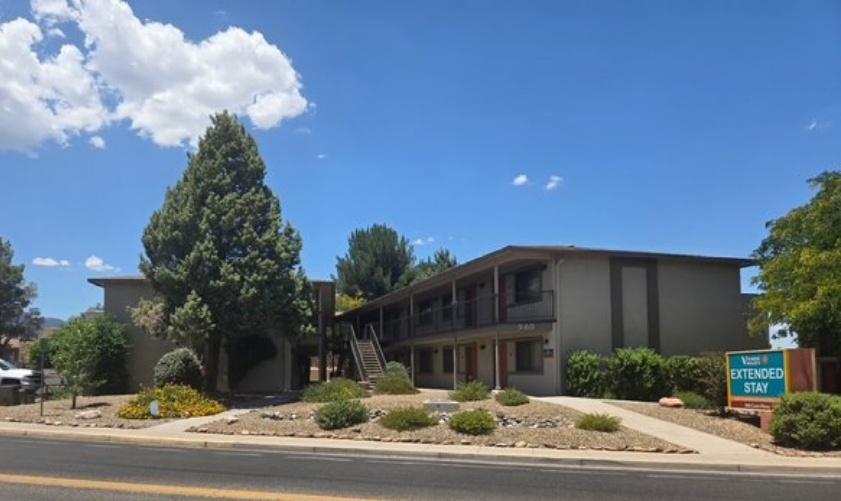
The Cottonwood Cove Apartments’ 34 units are meant to be “workforce” housing, HSNA CEO Devonna McLaughlin said, not “affordable” housing.
Each unit is one bed, one bath with its own patio.
“The proposed rent for those folks [in Cottonwood Cove] up to 80% AMI would be $1,200 a month,” she said. “That includes utilities. So, if you factor … about $150 a month in utilities, that’s about $1,050 a month in rent.”
The nonprofit’s previous work in Cottonwood at Oak Wash Apartments, which received the Rural Housing Development of the Year Award in September from the Arizona Department of Housing, were made to be affordable housing.
“At Oak Wash, we’re charging $375 a month,” McLaughlin said. “Different population [from Cottonwood Cove], very much lower income.”
The property, located at the Verde Valley Extended Stay Hotel at 960 Cove Parkway in Cottonwood, would be HSNA’s fourth hotel conversion.
“It consists of three properties on Cove Parkway,” McLaughlin said. “So, property details: Two properties are adjacent to each other on one side of the road, and then the third property is directly across the street.”
Per contract, the apartments would stay as workforce housing for at least 30 years. Seventeen of the planned units are restricted to 80% of the county’s AMI, 10 would be restricted for 90% AMI and the remaining seven would be cut off at 100% AMI.
Affordable Housing Study
The average rent in Cottonwood in 2025 was about $1,309, with a 4.5% vacancy rate, according to Rick Merritt, the president and one of the founders of Elliott D. Pollack & Company.
Merritt said the firm conducted the study as a follow-up to a 2021 study, to better understand the needs of the area and how they’re shifting.
One of the most notable shifts his firm saw was the aging population. In five years, the average age of a Cottonwood resident rose from 46 to 55.
“What we’re finding is that, probably, you’ve been discovered as a place to retire,” Merritt said. “There’s a lot of retirees coming here. … Your housing costs are less than on the other side of the mountain in Prescott and Prescott Valley.”
“The other thing we found is that your median incomes overall for homeowners and for renters are quite a bit lower than the county average.”
The county overall has seen a 32.7% increase in its income over five years, while in Cottonwood, the income increase is 14.0%.
Housing and renting costs alike have risen in the 2019 to 2025 timeframe of the study. Cottonwood apartment rent increased by 24%. Single-family home prices increased by 50% and condo and townhome costs increased by 66%.
The county overall also sees an home ownership rate of 75.1% as of 2024, while it is 53.6% in Cottonwood.
Housing Gap
“Affordable housing is typically used to describe housing for low and moderate income households,” Merritt said. “Typically, they earn less than 60% of the area median income, and … it’s a county-wide number, so it’s earning less than $51,000 or so. Because of the difficulty in reaching low and moderate-income households, it usually comes from state and federal programs like public housing, Section 8 vouchers, low-income housing tax credit projects, which you have several now.”
Those who earn too much to qualify for affordable housing still have a hard time finding housing options affordable to them, he said.
The ideal, Merritt said, is for people to spend 30% or less of their income on housing costs including utilities, which means those who don’t qualify for affordable housing might still end up spending more than what’s ideal.
“What you typically have is a shortage of units at the bottom end of the market … [and] you have a shortage of high end housing,” Merritt said. “But everybody’s trying to find housing in the middle, so the people with higher incomes, they’re able to pay less than 30% of their income on housing. The people on the left side that have the lower incomes, that they’re paying more.”
In Cottonwood, 30.1%, or 1,065 households, are paying more than 30% of their income on housing.
Additionally, 17.3%, or 610 households, are paying more than 50%, as of 2024, which Merritt said is on par with the rest of Yavapai County.