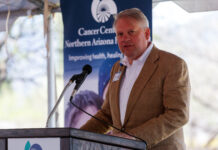

Northern Arizona Healthcare announced on Thursday, Sept. 4 its plans to construct a nearly $40 million integrated cancer-treatment center on the Verde Valley Medical Center campus in Cottonwood. Construction of the facility, which includes 30,000 square feet of clinical care space, is slated to start in late winter 2026 with the first patients anticipated in the fall 2027 according to NAH Chief Operating Officer Robert “Bo” Cofield.
“We are so excited to announce NAH’s future cancer center in Verde Valley,” NAH CEO Dave Cheney wrote in the announcement and said all of NAH’s cancer services in the Verde Valley will be moved to the new center. “Integrating all cancer services in Cottonwood will provide better service to all oncology patients, including those from Sedona.”
Once the first patients are accepted at the new facility, the Cancer Centers of NAH in Sedona will be closed and all of its staff will be transferred to Cottonwood.
“We have no plans to shutter the Sedona Medical Center, or the services that are provided there,” Cofield said. “The services that are provided there for cancer care, will continue, but they’ll just be relocated to Cottonwood and 80% of the patients who are utilizing those services in Sedona actually live closer to the Cottonwood location than to the Sedona location.”
The decision will allow patients to potentially see multiple providers in a single day.
“The project is a $39 million project, but our board had already approved a replacement of the linear accelerator in Sedona, so that’s a $4 million component,” Cofield said. “So, we’re calling it a $35 million project from what we have to manage at this point. But it’s nearly a $40 million project.”
The purchase of new equipment and the construction of capital projects, Cofield said, will improve both patient care and NAH’s ability to recruit and retain staff. For example, he previously noted NAH has an MRI machine housed in a semi-trailer outside of radiology at Flagstaff Medical Center and said capital constraints also affect the organization’s ability to recruit doctors.
“One of the things we have struggled with is providing consistent medical oncology to the Verde Valley community from a provider perspective,” Cofield said. “Our nurses, infusion techs and similar staff have been fairly consistent, and our medical providers have been consistent as well, but they haven’t lived in the community. Part of the reason is that when we bring recruits on site and show them they have to work in three places, they’re not excited. But the Cancer Center … [will be] a single location where care happens all in one relatively close proximity or building. We’re excited about how this can help us recruit.”
The new facility will be located off State Route 89A next to an existing walking trail that will be rerouted and the additional parking needs will be accommodated within VVMC’s existing parking infrastructure.
“We want to maintain the availability of that walking trail, not just for our own employees who use it, but for the community as well,” Cofield said and added the trail and center should be a “healing environment.”
“From a design perspective, what we expect to have is a fair amount of green space, almost a park-like environment surrounding the building,” he said. “We anticipate the potential of a live roof, meaning that it’s a green space with a veranda or patio adjacent to it. Then our clinic rooms and our infusion spaces will have views of the Mingus Mountains that currently you don’t get in our existing spaces.”
Although staffing models have not yet been finalized for the new Cancer Care Center, Cofield said construction and an increase in the volume of care “has the potential” to increase NAH’s staffing levels. Also its program along with its support services such as counseling and survivorship programs will be scaled up.
NAH does not see any major hurdles or delays to the start of construction, according to Cofield,
“As of now, we don’t have a publicly available image, there is only a schematic diagram, which wouldn’t be applicable to the public,” NAH Senior Public Relations Specialist Lauren Silverstein wrote in a recent email.
“We have some filings yet to make, because we have some design left to do, and so the facility is not yet fully designed and assessed to code,” Cofield said. “Once that is the case, we’ll finalize the process with the city of Cottonwood.”