
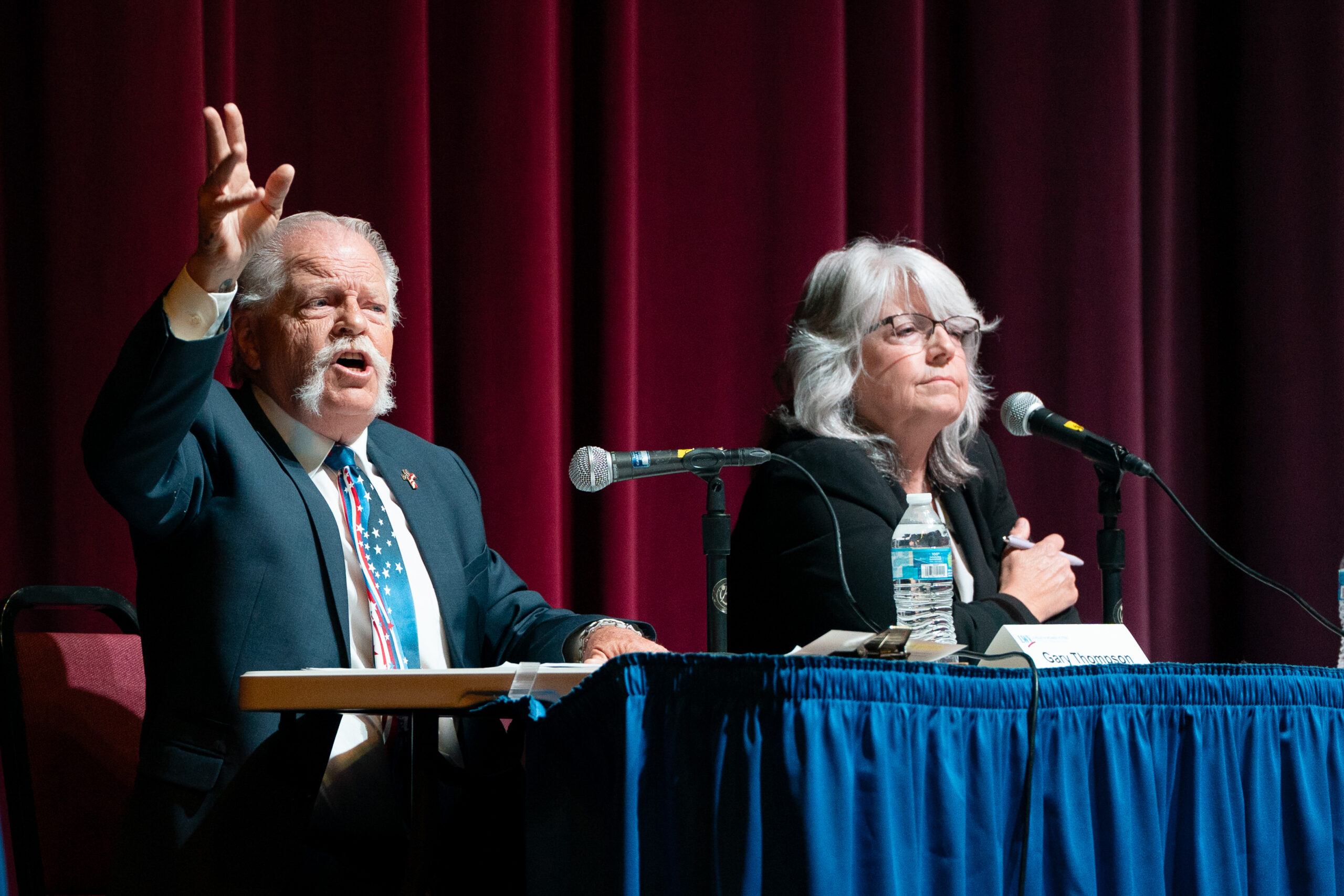
Vice Mayor Wendy Escoffier and newcomer Gary Thompson answer voter questions
The two Camp Verde mayoral candidates — Vice Mayor Wendy Escoffier and political newcomer Gary Thompson — say they want to advocate for the Town of Camp Verde by lobbying representatives at the state and federal levels.
“This is ours, not theirs, and they think it’s theirs,” Thompson said during a candidate forum, hosted by the League of Women Voters of Northern Arizona on Thursday, June 18. “It is our town. We need to be the ones that regulate it. It needs to be the mayor down, because that’s who you’re hiring — is the mayor, not the town manager in charge.”
Escoffier told the audience of about 50 people that the town is already lobbying and needs to keep it up.
“I’ve met with [Arizona State Rep.] Selina Bliss [R-District 1]. I’ve been with the mayor. We’ve gone down there [to the state capital],” she said.
“We’ve given testimony on different legislation that they’re passing that impacts us, but it’s not just Camp Verde that it affects. It’s all the smallertowns as well, things that they’ve done — taking away the right for us to review subdivision.”
The two are running in the Tuesday, July 21, primary election; early ballots go out this week.
Both said they want to advocate for the residents of Camp Verde and want to keep communication as open as possible.
“My door will always be open,” Thompson said. “I know they’re talking about moving the … council’s offices to some off-site spot where you’ll have a hard time finding it. I’m going to say that the mayor’s office should be in Town Hall — direct up front — and it’d be open at all times. Come down, talk to me. Let’s get things going.“
Escoffier said she’s had success in hearing people’s voices through open call during council meetings, but there’s always more that can be done.
“I think we need to do more town halls, community meetings, and hear what people have to say,” she said. “We’ve also had a lot of success with the manager’s working groups for tourism, for rural water and for the general plan.”
Revenue and Growth
Both candidates agreed growth is the No. 1 issue facing Camp Verde.
“First thing we need to do is update and get our infrastructure out on Highway 260,” Escoffier said. “If we have water and sewer out there, then we can start increasing our sales tax revenue. We also want to make sure that we have good paying jobs, so that people can come here, work here, live here and be successful.”
She said the town collects no tax on food items, so the amount it can collect through sales is already limited.
Thompson agreed increasing sales tax revenue is one of the biggest things the town can do to get its budget under control.
“We need to consider allowing, like, a cannabis dispensary,” he said. “It’s not my thing, and I understand we don’t all agree on that, but there’s a huge tax revenue that comes from that. Our residents are already purchasing in nearby towns, thus providing them with a large tax revenue.”
A commercial cannabis farming operation opened in Camp Verde in 2016, but the town does not permit retail recreational marijuana sales within town limits.
Water
Thompson said one of the first things the town has to do in order to bring in those businesses is to extend water and sewer to the State Route 260 corridor.
“The town must secure an additional $600,000 addition to those sewer loans that’s already in the WIFA … which is Water Infrastructure Finance Authority,” Thompson said. “This is the only way to extend the businesses west on Highway 260.
I’d like to see a grocery store located outthere, … as well as full-service restaurants, retail.”
Escoffier said it would be a lot more expensive than that to put in as much sewer and water needed. She said they could do more to work with surrounding municipalities, too.
“We need about $20 million to extend that, not $600,000,” she said. “$600,000 is for the design, but then it’s another $20 million or more to actually bring the water and sewer out to West Highway 260. So that’s a lot of money.”
The candidates said the town also needs to continue the conservation efforts for the Verde River.
“We need to cooperate and get in touch with those that are in front of us, because water flows in one direction, in one direction only,” Thompson said. “And they’re in front of us, so they can contaminate our water. So, we want to make sure that doesn’t happen by monitoring.”
Escoffier said it’s important to maintain the relationships the town has with the Friends of the Verde River and other conservation conversations around the region.
“We need to make sure that we develop approvals for things on the river,” Thompson said, “to make sure it’s monitored closely to understand what’s going on at the river.”
Dark Skies
Escoffier, who’s advocated in the past for recommendations surrounding dark skies in Camp Verde, said she’s been working through the General Plan to update some of those ordinances.
“I mentioned in the General Plan, one of the things council is working on is updates to the code and the ordinances, and that includes the lighting ordinances,” she said. “Currently, we allow the highest movements for residential and commercial use than any other community in the Verde Valley.”
To preserve the dark sky, Thompson said it is important to continue to monitor the lumens Camp Verde puts out at night.
“We also have to remember that some people have to see to walk,” he said. “So maybe [we should] convince them that they need to turn the lights downward. ”