
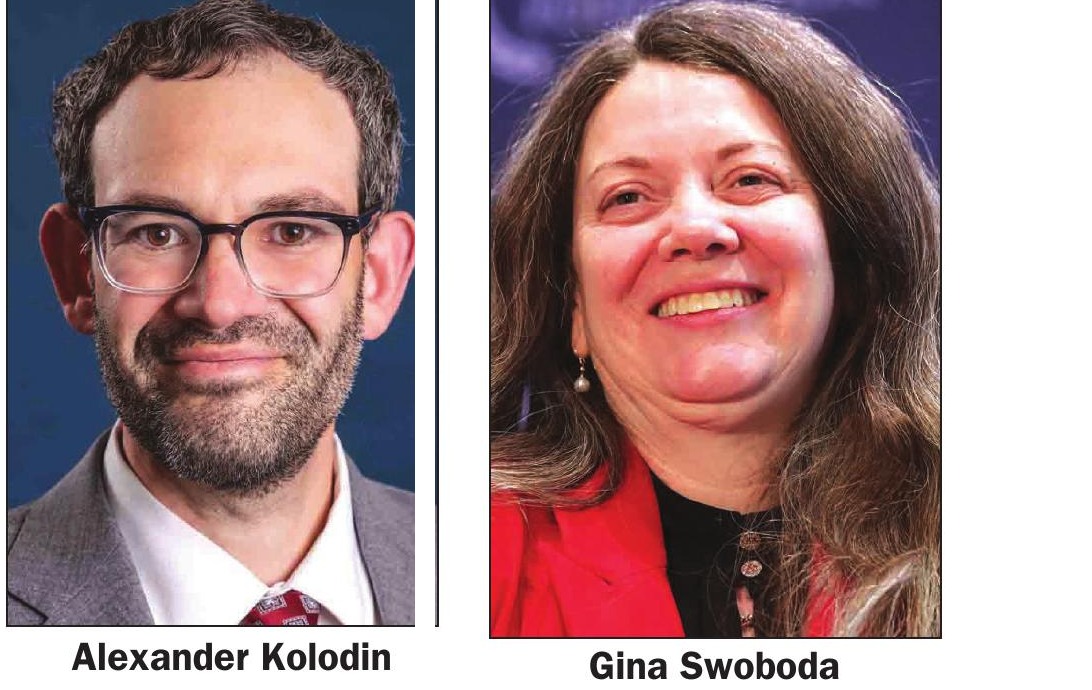
Kolodin, Swoboda debate election integrity, voter rolls
Arizona Secretary of State Republican candidates, Arizona State Rep. Alexander Kolodin [District 3] and Gina Swoboda, the former chairwoman of the Arizona Republican Party for the last two years, made their pitches to their party’s voters during a Yavapai County Republican Committee debate in Prescott on March 21.
The Secretary of State oversees elections, record keeping, business services and other state administrative functions. The office currently stands first in the line of succession to the governorship. However, that role changes in November, when Arizona voters will elect the state’s first lieutenant governor on the gubernatorial ticket, which came as a result of Proposition 131, approved by voters in 2022.
Kolodin framed himself as “shadow Secretary of State,” stemming from his court fights with incumbent Adrian Fontes [D], including successfully blocking the recorder in September 2020 from instructing voters how to correct ballot errors after the Arizona Supreme Court ruled Fontes “exceeded his authority” with the unapproved cross-out instruction; and legislative work, such as passage House Bill 2785 in 2024 and House Bill 2022 that permanently moved the primary election date earlier in the year, from early August to late July.
Kolodin did not mention his legal losses, principally his 18 months of probation by the State Bar of Arizona in December 2023, and $2,700 in court costs for bringing cases that were not backed by evidence including the “Kraken” lawsuit. A federal judge dismissed Kolodin’s cases in the Republican bid to overturn Arizona’s 2020 election results in which then-former Vice President Joe Biden defeated then-incumbent President Donald Trump.
“I worked under Secretary Michele Reagan and Secretary Katie Hobbs,” Gina Swoboda said, the first a Republican, the second, a Democrat. “I was the campaign finance and lobbying director. I was in charge of candidate filing, initiative filing, monitoring the logic and accuracy results that come from the counties.
“I built the Voter Reference Foundation over the four years before I became the chair. President Trump called and asked me to take over the party because we were in a little bit of trouble.
“In that capacity, I worked on voter list maintenance for the entire United States. So I know the election system of every single state in this country, and I’ve also served you in a political hat.”
The most important thing Swoboda stressed is the 2027 Election Procedures Manual — that determines how elections are conducted across all 15 of Arizona’s counties — and repairing the lobbying and campaign finance software to better see “where the flow of money is going.”
The candidates were questioned on how they would tackle public skepticism about election results in Arizona, especially considering recent actions by U.S. Department of Homeland Security. Earlier in April, Fontes and Attorney General Kris Mayes [D], jointly wrote a letter to county recorders advising them not to provide unredacted voter files to the federal government amid investigations by Homeland Security Investigations and the FBI into Arizona’s 2020 election.
“Twofold, one, our ICE agents are absolutely heroes and are very important part of making sure that there aren’t non citizens in our country in order to vote,” Kolodin said. “In terms of what DHS and also [Department of Justice] are doing on the side of suing Fontes to try to get the information on a voter roll so they can make sure that there aren’t non citizens on those voter rolls. I would absolutely support them in that effort as well.”
Since 1982, the conservative Heritage Foundation has documented 1,620 confirmed voter fraud cases out of roughly 1.3 billion presidential ballots cast nationwide since then.
“President Trump has Harmeet Dhillon from DOJ, who was with me in ‘The War Room’ in 2024 and who I’ve worked with for close to a decade now, requesting the voter lists from Secretary Fontes, and he’s refusing to give them to her. It’s important that the Secretary cooperate with the federal government where they’re in compliance,” Swoboda said.
The candidates discussed the Electronic Registration Information Center (ERIC), a partnership across state governments that cross-checks for duplicate voter registrations across state boundaries. While both endorse removing Arizona from ERIC, Kolodin stressed the secretary’s role as chief elections officer and endorsement by three Republican county recorders as evidence he can lead that push.
Swoboda stressed that it takes a majority of state county recorders to withdraw.
“So the secretary cannot unilaterally withdraw from ERIC,” Swoboda said. “In my work at the Voter Reference Foundation, we got 17 states on board with starting to pull out of ERIC. So there are fewer Republican states in ERIC than there ever have been, and they are starting to work together. I worked with Ohio Secretary of State Frank LaRose to help build his archive of data, and he’s now working with other states, that’s the way to do it.”
The voter registration deadline for the primary election is Monday, June 22. The primary election is Tuesday, July 21. The winner will face Fontes and Green Party candidate Duwayne Collier, who are both running unopposed for their parties’ nominations.