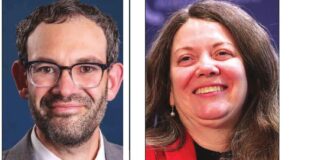

Yavapai College Governing Board Chairwoman Deb McCasland [District 2] sent an email to board members requesting they sign the board’s Code of Ethics before the academic year began in early September.
After a full semester — and nearly a year of debate surrounding the policy — two of the five board members have refused to sign it: District 1 Representative William Kiel and District 3 Representative Toby Payne, who represents Sedona, Cottonwood, Clarkdale, Jerome and parts of Cornville. District 1 covers Prescott to Yarnell.
The board members say the code forbids board members from speaking with college staff and the press and that they must publicly support the college president.
When asked whether she’d signed the code, McCasland, who represents Camp Verde, said, “Of course, I signed the Code of Ethics. The document guides us as board members.”
She did not respond to a request for further information about the policy.
On Jan. 19, Payne sent an email to McCasland requesting to add certain Code of Ethics sections onto the agenda for discussion with the whole board.
“I am deeply and sincerely disturbed by the current tension within the governing board and between the board and YC administration,” he wrote. “After reviewing Policy 310, Resolution 2024-18, Arizona State Statutes, and the Higher Learning Commission’s Criteria for Accreditation, I have identified several critical areas requiring attention, conversation, and deliberation among governing board members.”
The board has 24 policies listed on its website with specific focus areas. Policy 310, the Code of Conduct and Ethics, states board members will not speak with any staff member of the college.
“Each board member will refer all of their concerns and constituent concerns via email to the president to resolve or answer,” the policy states. “Board members never speak or act on behalf of the college, unless instructed to do so by a majority vote of the board.”
Payne authored a guest opinion the NEWS published in May about the policy and McCasland’s repeated refusals to agendize it.
“Why the board chairwoman continues to disregard the plain language of our own policy is both troubling and difficult to comprehend,” he wrote. “Her refusal raises serious concerns about procedural fairness and the integrity of board governance.”
The ethics code was never brought to the board for discussion in 2025.
Free Speech
The policy also requires board members to provide “visible support” for the president, “counter misinformed public criticism” and precludes members from speaking to the press “in any way that reflects negatively on their colleagues, the president or the college.”
Kiel said this is one of the major reasons he did not sign it.
He said he doesn’t see the point in being unable to speak with some of his constituents just because they “happen to be employed by the college,” especially because many of his own constituents are staff members.
“I have no financial reason not to sign it,” Kiel added — board members are elected officials and serve unpaid.
Additionally, preventing an elected official from speaking to the press in any way, including in a negative way toward problems the college might have, doesn’t seem right, Kiel said. Not everything can be solved if you only look at the good stuff, he said.
McCasland said she’s seen other boards at other colleges have votes of no confidence for their presidents and it’s important to not have that lack of confidence in the community, so the board must stay positive toward college President Lisa Rhine, the rest of the board and the college.
It’s “very disheartening when you’re president and your faculty just voted to say, ‘we don’t think you’re doing a good job,’” Ken Burke, Association of Community College Trustees workshop consultant, said during a board workshop in January.
McCasland hasn’t always followed this policy.
“I, personally, believe that [former college President Penny] Wills’ salary is too high,” McCasland said to the NEWS in 2016, in reference to Rhine’s predecessor. “Compared to local pay scales, other research and the enrollment drop, definitely she is overpaid.”
She clarified it was her personal opinion, and not that of the board.
“Even if I am off, anything over $250,000 is too much — especially when the taxpayers and students are subject to repeated increases because the college needs more money to operate …. Since Wills’ hiring, she has received very generous salary increases from the board,” she said in 2016.
After receiving Payne’s request in January, McCasland instead put a discussion on Policy 308 to the agenda, which includes processes of placing items on the agenda for discussion.
“1. If it is the Board’s issue it will be placed on the next Board agenda,” the policy states. “2. If it is the president’s issue, the chair will refer it to the president to be addressed in accordance with board policy and inform any board member concerned. 3. If the board member feels that this process has not been followed appropriately, she/he will inform the chair who will place the matter on the next board agenda.”
While not the one he originally wanted to discuss, Payne said that one had issues with this one, too.
“Dr. David Borofsky, executive director, Arizona Community College Coordinating Council, in presentation [May 29, 2025] to the board, states that Policy 308 as written is not what the board intended when the board created the policy, and he recommended it be rewritten in a board policy workshop,” Payne wrote.
Borofsly said during the discussion, that the intent for the policy was for the matter of whether the board should discuss and take possible action should be on the agenda. So the board would have to discuss discussing it, but no board member could force an item onto the agenda for discussing the issue itself.
Yavapai College’s policy was not rewritten after the discussion.
No Change
Policy 310 also states “Once the board has decided on a policy or position, each board member must be prepared to honor the board’s decision.”
Kiel said he doesn’t want to speak ill of the college, but he wants to fix problems if they arise. Doing so requires recognizing past mistakes to correct them in the future.
During the last board meeting, McCasland said the board’s role is to look at the present and future only.
The board was discussing raising tuition, which it voted 4-1 to approve, when Kiel pointed out an $800,000 sign in Prescott almost offsets the extra revenue from the higher tuition.
“Marketing money is expensive. The sign helps,” McCasland said. “We just don’t look backwards.”
Representatives Patrick Kuykendall [District 4] and Steve Bracety [District 5], did not respond to two emails to each of them about whether they’d signed it.