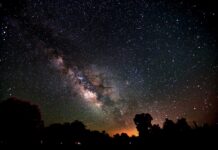

Ten miles outside Cottonwood, away from the lights of the dark sky community, a very small sliver of moon doesn’t make it much brighter. But this dark night, Wednesday, Oct. 22, should be a great one for stargazing.
Astronomers of Verde Valley will host its final community star gazing night of the year at Yavapai College’s Verde Valley campus, 601 W. Black Hills Drive in Clarkdale, from 6 to 9 p.m.
“We are on the Wine Center patio, but the Wine Center is closed,” club President Richard Bohner said. “We’ll usually start out with a tour of the sky with a laser pointer. … Point out major constellations and stuff like that.”
The event is free and open to the public. Its calendar and more information are on its website, astroverde.org.
Many club members will come with their telescopes and show off something different in the night sky. Each club member can pick which stars or stellar objects they show.
“Everybody has their own favorite type of ’scope,” he said. “There’ll be reflecting ’scopes, refractors and then what they call a compound ’scope. One of the common ones is called a Schmidt Cassegrain. It uses lenses and mirrors, and what it does is it folds the light — comes in, bounces off a mirror, goes up, bounces and then back down again. What that does is it makes the ’scope smaller, shorter and lighter. So that’s what I have.”
Bohner said there will probably be about six to eight telescopes to choose from, depending on which club members are available on the night, which he’s still working out.
“I know one of the people coming has a 10-inch Dobsonian, which is a reflector,” he said. “It’s kind of on … a lazy Susan-type mount. But there’s no electronics. You just have to move it. And you need to know the sky to find things.”
Because it’s October, in view are the fall constellations and several well known objects in the night sky, including the Orion constellation, the planet Saturn and the Orion Nebula in Orion’s Belt.
With the new moon happening the day before the viewing, just 0.8% of the moon will be visible on Oct. 22, according to theskylive. com, and the moon will actually set around the time the sun does, making viewings of these stellar objects even easier without the moon’s glare.
Each telescope operator will give some facts about whatever their telescope is pointed at.
“If you’re looking at the Orion Nebula [they’ll] tell them what I just told you,” Bohner said. “It’s 1,500 light years away. It’s a starforming region; new stars are being born there. The radiation from these new stars illuminate the rest of the nebulosity, the gas around them. So that’s why it glows.”
Bohner has been invested in astronomy, particularly in the Verde Valley, for a long time. He teaches an astronomy class through Yavapai College’s Osher Lifelong Learning Institute, which is designed for older adults, and can have between two and 20 people in his class. The start date for the next six-week long session is in late January and classes generally run 90 minutes once a week, usually on Tuesday mornings.
The club hosts several community events like this annually. This is the 10th of this year. The club had to cancel the 11th, originally planned in November, because of scheduling conflicts.
“I’ve been the president for about two and a half years,” he said. “I’ve been in the club, though, since 2006 and the club started in ’98.”
The club hosts club-only meetings monthly. Family membership for the club is $20 per year, according to a club pamphlet.
“We have an enthusiastic and varied membership that includes scientists, professional astronomers, teachers, authors, students and big city refugees from all walks of life,” the club’s mission statement on its website reads. “Our mission is to inform, educate and entertain by providing a varied and interesting program of activities for our membership and the communities we serve.”
Bohner said his favorite part about these events is that they’re for everyone in the community and they try to be exclusive at all. He’s hoping for about 100 people at the Oct. 22 event.
“Lots of the people haven’t even looked through a telescope their whole life,” he said. “And having kids there, you know, a lot of times they look, ‘wow.’”
“It’s amazing to watch young minds discover something different than this,” he mimed scrolling on a phone. “And even older people, though. I’ve had people — never had looked through a telescope, and they got a chance to look through our ’scope.”
In addition to being the president of the astronomy club and teaching college astronomy courses, Bohner also “helps to photographically document events at Lowell Observatory,” according to the International Astronomical Union’s Small Bodies Nomenclature bulletin published in January.
“Lowell has this program where they’ve discovered something like 16,000 asteroids,” Bohner said. “So whoever … discovers them has the right to name them, so now they’re naming them after people that do stuff in astronomy.”
Lowell Observatory named asteroid in his honor: 30255 Bohner (2000 HK26). It’s about 1 by 2 kilometers in size and orbits in the Main Asteroid Belt between Mars and Jupiter.