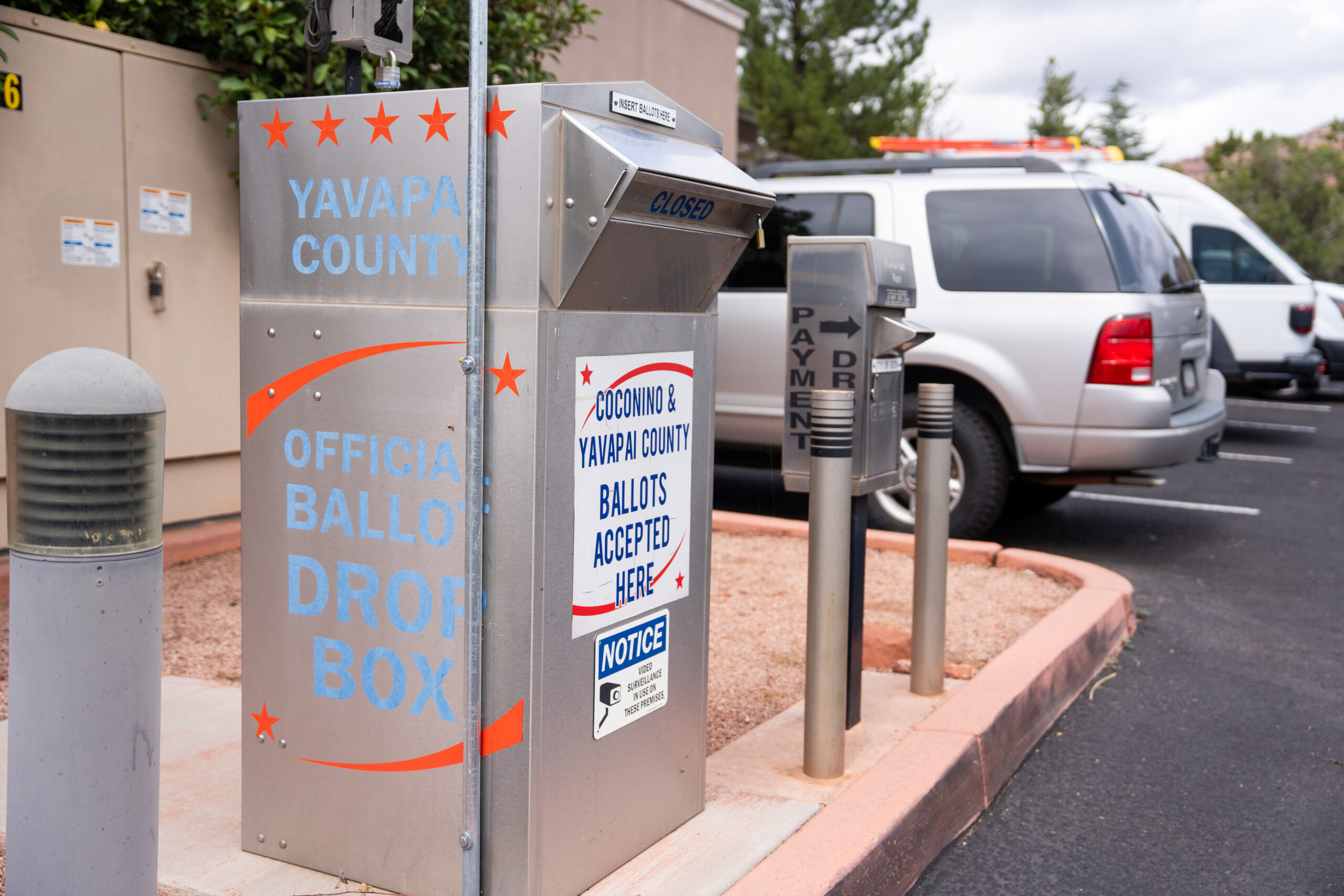
As it’s becoming something of a tradition in Arizona, voters will have eight different legislative propositions to vote on sent to them by Republican lawmakers to get around the veto pen of Gov. Katie Hobbs [D], who canceled many of the propositions that had been sent to her as regular bills. Additionally, the Yavapai County Board of Supervisors is asking voters how they want to fund the jail district.
■ Proposition 141, Vehicle Mileage Tax Ban: Seeks to bar any government entity from imposing a tax or a fee based on the number of miles a person travels in a motor vehicle and prohibits officials from monitoring or limiting the number of miles a person travels in a motor vehicle, unless the person consents. It was sent to the voters through Senate Concurrent Resolution 1004, the Freedom to Move Act, sponsored by Sen. Jake Hoffman [R-District 15].
“One specific tool being used to implement the anti-car, woke transportation agenda is vehicle mileage limits and taxes,” the conservative special interest group Arizona Free Enterprise Club wrote in a June 2025 press release. Washington State “passed a law that sets a target of reducing vehicle miles traveled per capita by 50% by 2050. Their department of transportation is empowered to create policies and strategies that would effectively force people to give up their cars.”
Opponents argue that Prop. 141 will prohibit the government from being able to ensure that electric vehicles are paying their fair share of road maintenance, which is currently largely supported by gasoline tax in addition to vehicle registration.
“Rather than allowing policymakers to explore future solutions, Proposition 141 would permanently prohibit consideration of vehicle-miles-traveled funding options, even voluntary or pilot programs designed to evaluate whether such approaches could work for Arizona,” Southern Arizona Leadership Council CEO Ted Maxwell wrote in the publicity pamphlet.
■ Proposition 142, DEI/Preferential Treatment Restrictions: Sponsored by Arizona Speaker of the House Steve Montenegro [R-District 29], who crafted House Concurrent Resolution 2044 with the conservative Goldwater Institute. Prop. 142 seeks to broaden the state’s 2010 anti-discrimination ban to bar public entities from requiring applicants, employees, students or contractors to endorse racial or ethnic preferences and would limit university diversity, equity and inclusion spending and instruction.
“There is simply no justification in the 21st century for creating different rules for Arizonans based upon race, no matter what labels are used,” Goldwater Institute President & CEO Victor Riches wrote in the arguments for the proposition. “We should celebrate the rich history and heritage of Arizonans from all backgrounds and walks of life, not squander taxpayer dollars in support of racialized policies and programming that pits Arizonans against each other.”
Opponents argue that it will have a chilling effect on academic inquiry. “Ideas are not illegal and there is no ‘government-approved’ speech exception to the First Amendment,” Darrell Hill, policy director for the ACLU of Arizona, wrote in June. “The state cannot adopt a policy or rule that punishes faculty, administrators or students for expressing their beliefs or prohibits wide scopes of ideas from being debated at universities.”
■ Proposition 144, FAST Election Results Act (Arizona Secure Elections Act): Sent to the voters through House Concurrent Resolution 2001 by Arizona Rep. Alexander Kolodin [R-District 3], who is seeking to replace Arizona Secretary of State Adrian Fontes, the Democratic incumbent.
The major changes Prop. 144 seeks is requiring voters to show government-issued proof of identity when voting in person or by mail, however it is unclear how that would actually be enforced. Additionally, 144 reduces the list of acceptable voter IDs by disallowing utility bills, insurance cards or bank statements. It would also prohibit a foreign national from making contributions to influence an Arizona election, which is already illegal in candidate elections but not ballot measures.
Opponents, such as the ACLU, argue that the FAST Act is redundant since voters are already required to show ID to vote and creates more red tape getting in the way of quicker election results — and that it bundles unrelated actions.
■ Proposition 316, Municipal Food Tax: Asks voters if they want to cap the grocery tax rate at 2% and would require municipalities to get voter approval to increase existing tax rates or to put new taxes in place. It was put to the voters through House Concurrent Resolution 2021, with Rep. Leo Biasiucci [R-District 30] as the lead sponsor.
■Proposition 317, Drug Cartel “Terrorist” Designation: Declares drug cartels “terrorist” organizations and directs the Arizona Department of Homeland Security to address the threat. It was sent to the voters through House Concurrent Resolution 2055, also sponsored by Montenegro.
“This resolution gives the Trump administration another tool to defend our state, uphold the rule of law and protect innocent lives,” Montenegro wrote June 30, 2025. “A do-nothing bill,” is how the Coconino County Democrats label Prop. 317, in a March 31, 2025, press release.
Proposition 318, Student Athletics: Asks voters to mandate that student athletes play in interscholastic and intramural sports based on the biological sex on their original birth certificate. It was sent to the voters by House Concurrent Resolution 2003, sponsored by Rep. Selina Bliss [R-District 1], who represents Sedona and the Verde Valley.
It also requires bathrooms, locker rooms and showers in K-12 schools and private sports leagues, such as Little Leagues, and prohibits athletes from using facilities that do not match their sex assigned at birth. Proponents argue that it promotes fairness in sports; opponents argue it is invasive and baseless.
■Proposition 319, Photo Enforcement: Sponsored by Sen. Wendy Rogers [R-District 7], it would prohibit municipalities from adding photo enforcement systems after the end of 2026. Governments that have a contract in place would have to get approval from their voters at the next general election to continue to operate their photo enforcement systems. If voters in those municipalities approve the local extension, that would be good for 10 years and would require reapproval at the end of the term.
Proponents argue that photo enforcement can amount to mass surveillance and is driven by profit motive. “The Insurance Institute for Highway Safety found red-light cameras cut fatal red-light crashes by 21%,” AAA Arizona Government Affairs Director Michelle Donati wrote in the arguments against. “They also stop violent, high-speed side impacts — the crashes most likely to end in tragedy.”
■Proposition 320, School District Budgets: Would require that school districts with over 7,500 students spend at least 60% of their operating budgets on direct instruction, increasing by 0.5% yearly or lose 25% of their Classroom Site Fund allocation from the state of Arizona. It was sent to the voters through Senate Concurrent Resolution 1032, sponsored by Sen. Jake Hoffman [R-District 15]. No school districts in Sedona or the Verde Valley meet that student threshold.
■Proposition 497, Yavapai County Jail District Funding: The Yavapai County Board of Supervisors is asking voters in the county to increase the Jail District’s sales tax from 1/4 of a cent to 1/2 of a cent per dollar. If passed, the new rate would go in effect on Thursday, July 1, and be in place for the next 20 years.
Supervisor Nikki Check [D-District 3], who represents Sedona and the western Verde Valley, has predicated much of the pitch to voters on the argument that an increase in the sales tax would allow the board to shift some of the funding burden onto tourists and lower the property tax levy in response.