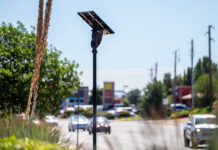

During the first week of July, the city of Sedona followed the lead of Cottonwood, Scottsdale and other cities by placing four portable signs that read, “It’s OK to say NO to panhandlers,” adding “Contribute to local charities instead.”
The signs costing $251.80 each are currently located near grocery stores at Rodeo Drive and State Route 89A, Coffee Pot Drive and SR 89A and Soldier Pass and SR 89A and also in Uptown.
“The main goal [of the signage] is to encourage the community to direct their charitable giving toward local organizations that offer long-term, structured support for those experiencing homelessness or in need, rather than giving directly to panhandlers who might use funds in unproductive ways,” Sedona Police Department Patrol Cmdr. Chris Dowell wrote in a recent email.
Dowell identified some potential concerns about direct giving, including funds possibly being used for “illicit activities such as drug or alcohol abuse.”
The signs were discussed during a Sedona City Council priority session in the spring, according to Mayor Scott Jablow. They were approved by the Sedona Police Department, reviewed by the city attorney, and ultimately authorized by the city manager.
“These signs are on private property,” Jablow said. “Each of the store owners had requested them because each of them have been getting inundated with panhandling. … There was interest from the property owners, and even the public has been saying, ‘I’m tired of seeing panhandlers at the stores.’ People can panhandle on the city streets, they’re allowed to do that, and it’s more or less to keep them off the private property.”
Dowell emphasized that the signs do not ban panhandling, which is protected speech under the First Amendment and the 2015 U.S. Supreme Court ruling in Reed v. Town of Gilbert that prevents the government from banning panhandlers holding signs.
Dowell also noted that there is no outreach or awareness campaign directly tied to the new signage. However Dowell did cite that the City Council recently approved a new SPD position for a community outreach officer, who will focus on Sedona’s homeless, in addition five new patrol officers and three new motor officers as part of its $103 million budget.
“[The] outreach services officer will be increasing collaboration efforts with local resource providers and performing outreach to individuals experiencing homelessness,” Dowell wrote.
According to a report from the Urban Institute, effective homelessness responses must prioritize housing first before addressing other challenges.
“Success evaluation for this signage initiative does not involve specific measurable metrics,” Dowell wrote. “No formal goals or metrics are currently being tracked aside from an indirect assessment — specifically, for those who are panhandling to be connected better to resources and encourage people to donate to local organizations that offer these resources to those in need.”
There are currently no plans to increase the number of signs; more may be added in Sedona if panhandling patterns change.
“As of now, only three weeks since the installation, there has not been sufficient time to observe or measure changes in panhandling behavior,” Dowell wrote. “The locations have not been specifically monitored since the signs do not legally prohibit panhandling activity.”
No formal written feedback from the community has been given to SPD about the signage yet, Dowell said.
Sedona’s signs do not direct people to any specific local charity or website, Dowell said, in order to “to maintain neutrality and allow individuals to choose which organizations to support.”
“The [Sedona] program intends to … reduce the visibility and frequency of panhandling by redirecting donations toward local charities, which can provide more comprehensive and sustained assistance,” Dowell wrote. “Charitable donations directed to professional organizations are efficient because they provide structured support services, including housing, health care, addiction treatment, job training and long-term stability.”
“The initiative was informed by research on similar successful programs in other cities, as well as feedback and requests from local businesses and residents who wanted a structured approach to addressing panhandling,” Dowell wrote.
“Feedback from local business owners and residents has been generally positive. At this point the community seems to appreciate the city’s approach,” Dowell wrote.
Cottonwood’s signs, however, direct people to the website CottonwoodCares.org that Cottonwood Police Department Outreach Service Officer James Repp said has seen “more visitors and more donations, especially when the signs were first introduced,” however he did not provide specific figures.
“CottonwoodCares.org has recently undergone enhancements to better assist homeless individuals, Repp stated.
“This program allows officers in the field to access funds that can provide immediate support,” Repp said. “While local social services often have financial resources available, these funds can be difficult to access during weekends or late at night. In contrast, CottonwoodCares funds are readily available when urgent assistance is needed.”
If Cottonwood officers encounter someone unsheltered during freezing temperatures and the local shelter is full, they can use CottonwoodCares.org funds to secure a motel room for the night, providing a warm place to sleep and the opportunity to connect with additional local services.
“Examples of how the Cottonwood Police Department leverages CottonwoodCares.org to support our community can be found on our social media pages,” Repp wrote.
However, the effect of financial donations to charities can be diminished by the overhead expenses these organizations incur. Nonprofits typically spend an average of 18.3% of their funds on overhead costs. In contrast, research published by the National Bureau of Economic Research on direct giving experiments showed that every dollar given directly generates an economic benefit of $2.40 within the community according to a 2012 study from Georgia State University.
“While there isn’t a lot of research on this, there also is no research showing putting up those signs does anything to raise significant funds for nonprofits and actually make a dent in homelessness,” Legal Director for the National Law Center on Homelessness & Poverty Eric Tars said in an interview with the Scottsdale Progress in June 2019.
The Sedona Area Homeless Alliance declined to comment to the NEWS.