

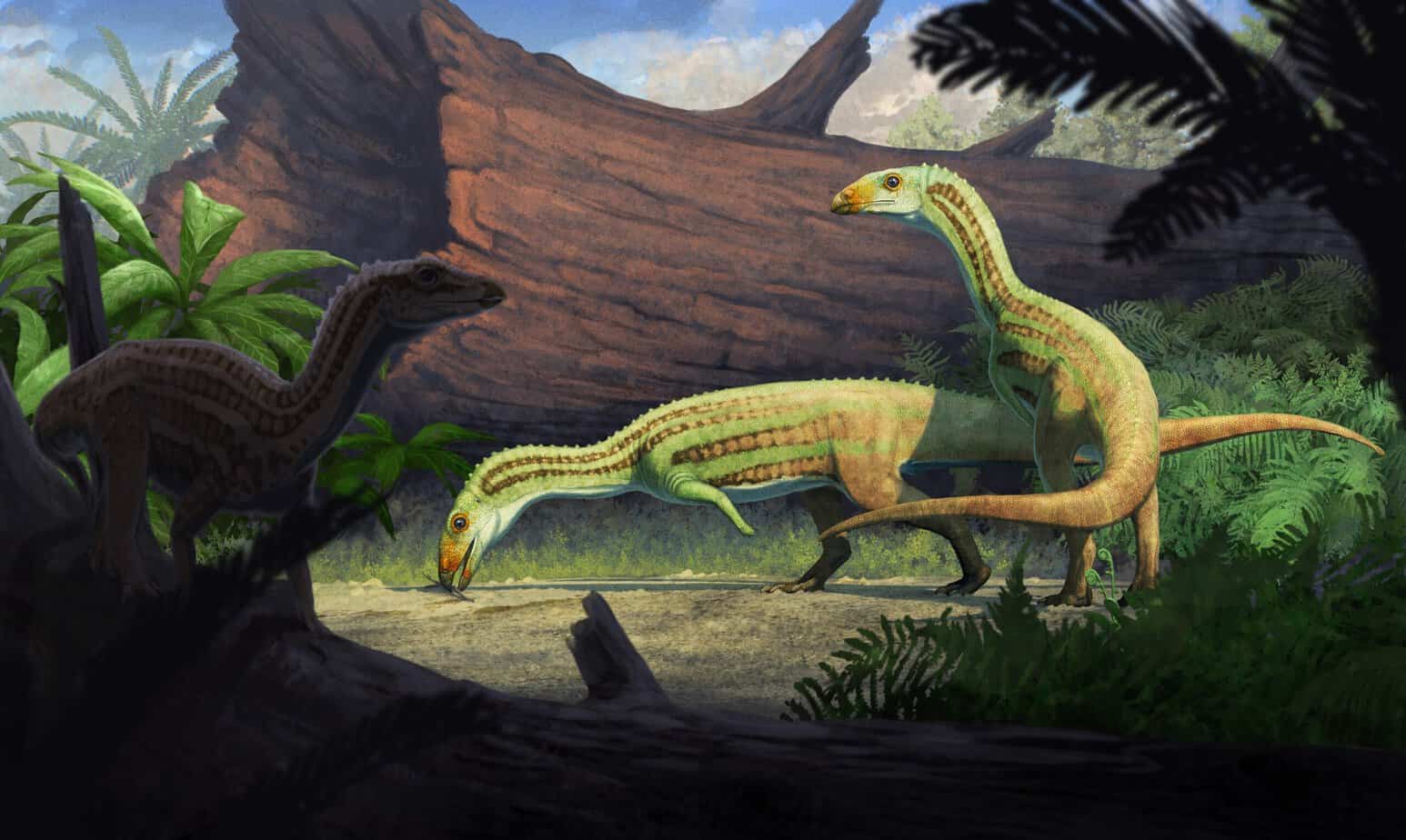
New species of extinct reptile discovered in Petrified Forest
“A relatively small, bug-eyed, adorable-looking, two-legged crocodile creature with a toothless beak,” 25-inches tall, with a large eye socket and hollow bones is how Elliott Armour Smith, a paleontologist at the University of Washington, describes Sonselasuchus cedrus.
The newly identified species of extinct reptile roamed what is now Petrified Forest National Park in Arizona roughly 215 million years ago, in the Norian division of the late Triassic period.
Armour Smith is the lead author of a March 8 study published in the Journal of Vertebrate Paleontology formally describing the new genus and species. A member of the shuvosaurid family, an early relative of modern crocodilians, Sonselasuchus cedrus is helping scientists understand what made its dinosaur cousins so extraordinary.
“It challenges some of our assumptions about what made dinosaurs special,” Armour Smith said. “Whether it was their physiology, their growth patterns, or their ability to occupy different ecological roles. Looking at these very similar, convergently evolved groups, and asking why they ultimately didn’t succeed instead of the dinosaurs. It contextualizes this broader question about what made dinosaurs so dominant and successful throughout their evolutionary history.”
The fossils come from the Kaye Quarry, located west of Cedar Tank in Petrified Forest, first discovered in 2014 by Tom Kaye while he was volunteering with the University of Washington. Over the last decade, the locality has yielded about 3,000 fossils from at least 23 different species, ranging from fish and amphibians to dinosaurs and strange reptiles such as drepanosaurus — odd-looking tree dwellers with prehensile tails, according to Armour Smith.
The Kaye Quarry “doesn’t seem to show any signs of petering out,” its scientific potential the study’s co-author Christian Sidor wrote.
“What’s fascinating about this site is that it has more shuvosaurid fossils than any site in the world,” Armour Smith said. “It gives us a window into population level variation, and we can treat all of the limb bones in the site as basically one population. Although all the fossils are disarticulated, in this jumbled mess. We were still able to look at the individual measurements and proportions of how wide the ends of the limb bones are versus their total length. And when you plot these together, you’re able to look at essentially differential rates of growth.”
Armour Smith found that when he compared the 950 S. cedrus bones from at least 36 individuals, the hindlimbs and forelimbs grew at different rates. In juveniles, the limbs were about equal in size. However as the animals matured, the hindlimbs outgrew the forelimbs.
“We interpret that as evidence for a locomotory mode shift from quadruped as a young to bipedal adults,” Armour Smith said. “This is a really intriguing signal that we’re getting from the data.”
The identification of the new species comes from the upper jaw bone.
“In this case, it does not bear teeth, and it has very different proportions than other shuvosaurids and it’s very lightly built and that is what we attributed the species diagnosis, too,” Armour Smith said.
Part of Armour Smith’s dissertation is screenwashing sediment from Kaye Quarry to find smaller fossils not visible to the naked eye, to identify more species at the site and reconstruct the community of animals that S. cedrus lived alongside.
“We’ve done a lot of what we can to get the lowest sort of taxonomic level out of the larger vertebrates at the site, but I see potential in narrowing down some of those taxonomic identifications for the smaller fossils,” Armour Smith said.
The paleoenvironment of S. cedrus 215 million years ago was a different Arizona, being a tropical to subtropical climate, as the continent was part of the Pangea supercontinent.
“You probably would have seen some pretty dramatic swings between wet and dry as well,” during this time Armour Smith said. “Then with a lot of coniferous forests, and evergreen plants everywhere, but no flowering plants,” since the fossil remains of that group have never been found in rocks from this period of time.
The Kaye Quarry sits within the Sonsela Member of the Chinle Formation, deposited by a network of ancient braided rivers with high-energy, cobble-choked channels that zigzagged across the landscape rather than meandering slowly. This paleoenvironment is a possible explanation for why all the fossils at the site are a “jumbled mess,” that the animals’ carcasses were on the surface for a while and the river water proceeded to scatter the remains.
“My broad pitch for the importance of paleontology is fossils tell us a ton about the modern biota,” Armour Smith said. “There are many endangered crocodilian species around the world, and understanding the fossil record of living groups helps us think about their evolutionary story and therefore thinking about how to best protect these imperiled animals in the modern world.”


