

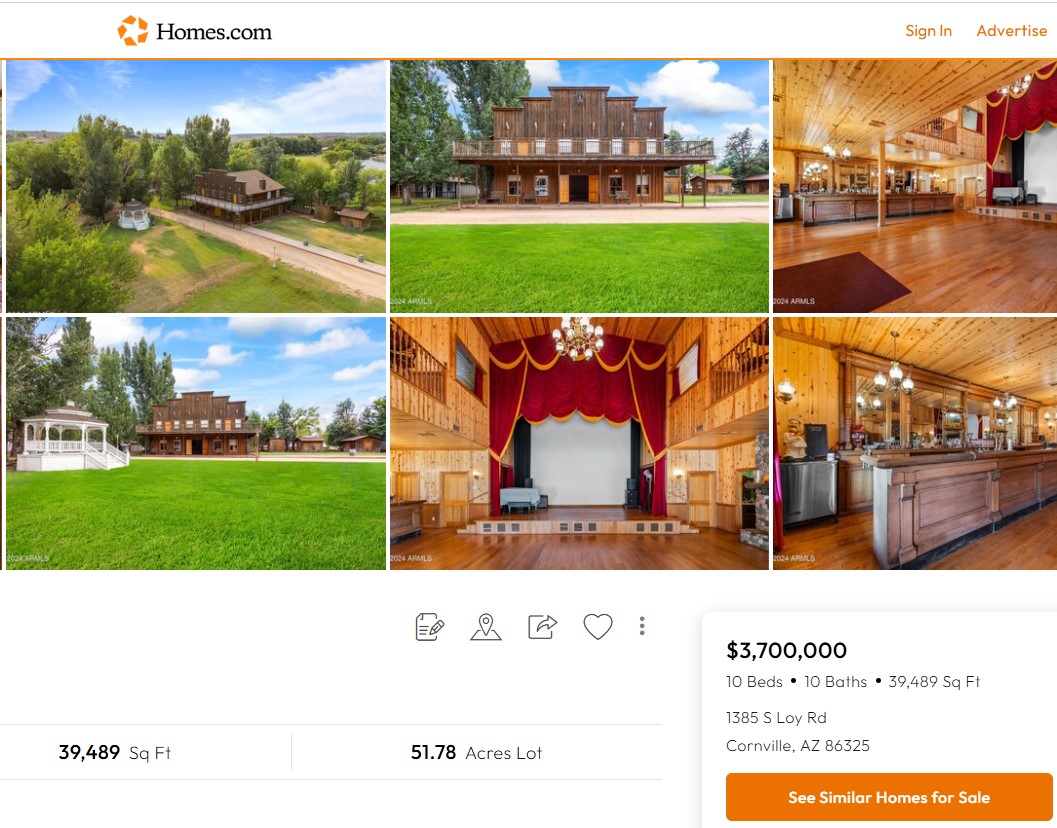

Developers Andrew Richards and Marc Slavin purchased Georgia Frontiere’s former ranch in January, and their concept sees 38 tiny homes for short-term lodging and the on-site Opera House restored as an event space.
A public meeting on their HÓZHÓ Springs concept is set for Monday, June 1, at 5 p.m. at 1385 S. Loy Road, in Cornville.
“We really want the guests to be able to hear the story behind this property … all the way back to the Loys, forwarding into Georgia Frontiere owning the property,” Richards said. “We just feel like there’s a lot of history that can be shared.”
The proposed project will be centered on the 52-plus acre property and will include the demolition of 30,000 square feet of current living space to replace it with small lodging and amenity areas. The on-site Opera House, despite its deferred maintenance, will be retained.
“We’re only forecasting that we would construct somewhere around 20,000 to 24,000 square feet of tiny homes,” Richards said. “So the total number is 38 tiny homes, and I know that that’s a really interesting number, but in some preliminary site layouts, it fits on the property very well. It works with some of the restrictions. And the thing that we had to be sensitive to is this waste treatment facility is very expensive.”
Richards’ goals in the concept is to preserve the agricultural component — for example, the alfalfa fields — acting as a buffer at the edge of the parcel.
“A second priority for us was maintaining the historical structures on the property,” he said.
Third, to eliminate many of the existing seven or eight septic systems.
“The majority of septic systems and tie a lot of the existing structures into a waste treatment facility that we’re putting in, and then obviously the new units,” Richards said, and the treatment facility’s cost also helped set the 38 unit target. “These are smaller units. The majority of the travelers who [will] come into these units will be couples or corporate retreats, so the density is low.”
Among the buildings that will remain are the Opera House, stone dwellings, a four-room hotel, old barn, an Old West facade with four rooms and two casitas above it, stables and clubhouse; along with what Richards has dubbed “Earl’s House” along Oak Creek.
“We will remove the main house in which Georgia lived in,” Richards said. “Unfortunately, the old part of the home was built on a rock foundation, and it’s failing and to preserve that would be very expensive. We will also remove a carriage house that has three casitas in the upstairs garage that sits back, along the creek. We will also remove … it’s another house that is full of mold, water leaks that no one ever did anything with.”
Richards said the property has a great deal of deferred maintenance that has accumulated since Frontiere’s death in 2008.
“The next structure that is being removed is I’m going to refer to it as the ‘Ice House,’ It’s a large storage building,” Richards said of the two-story building.
History
The ranch was built and owned by Frontiere — owner of the Rams NFL franchise from 1979 to her death — and her longtime partner Earl Weatherwax, an Arizona rancher. Frontiere used the property as her offseason home.
“She loved to play golf when she was young and was quite a good golfer, so she built a nine hole golf course on the front,” said Patrick Schweiss, longtime friend of the couple and executive director of the Sedona International Film Festival. SIFF has also held numerous fundraisers on the property.
The property reflects the couple’s interests: Weatherwax brought the ranching life and Frontiere, a trained opera singer, had a small Opera House constructed on the property, which most nights functioned as a private movie theater.
“It’s the only ranch in Cornville that has a nine hole golf course on the front of it,” Schweiss said. “She always joked and said, if you play it backwards, it’s 18 holes. … She needed a clubhouse so people could go and change, get ready, that kind of thing. And so she built tennis courts because she loved to play tennis when she was young. … They built the outbuildings to look like an old west town — like a movie set from an old west movie.”
An application to Yavapai County Development Services has not yet been submitted, but Richards said he will be applying for a Use Permit and a Minor Comprehensive Plan Amendment, so there will be plenty of opportunities for public feedback. An April 29 mailer sent to residents within a half-mile of the property implied the project would go through the city of Cottonwood rather than Yavapai County, Richards said — because Yavapai County P&Z’s offices are located in Cottonwood.
“Depending on how the neighborhood participation meeting goes, we would like to next apply for demolition permits while we’re working on architectural and engineering submittals,” Richards said.
“My heart is in agriculture and rural Arizona, and if I could ask for anything, it would be that the citizens hear us out and hear what our proposal is,” Richards said. “I really do believe we would be a great neighbor, and I would like the chance to share our vision and understand what the community’s feedback is with our vision.”
Comments and questions about the proposal can be directed to Richards at 970-630-2300 or andy@teamddi.com; comments can also be submitted to Yavapai County at info@yavapaiaz.gov using the subject line PRE26-000009.