
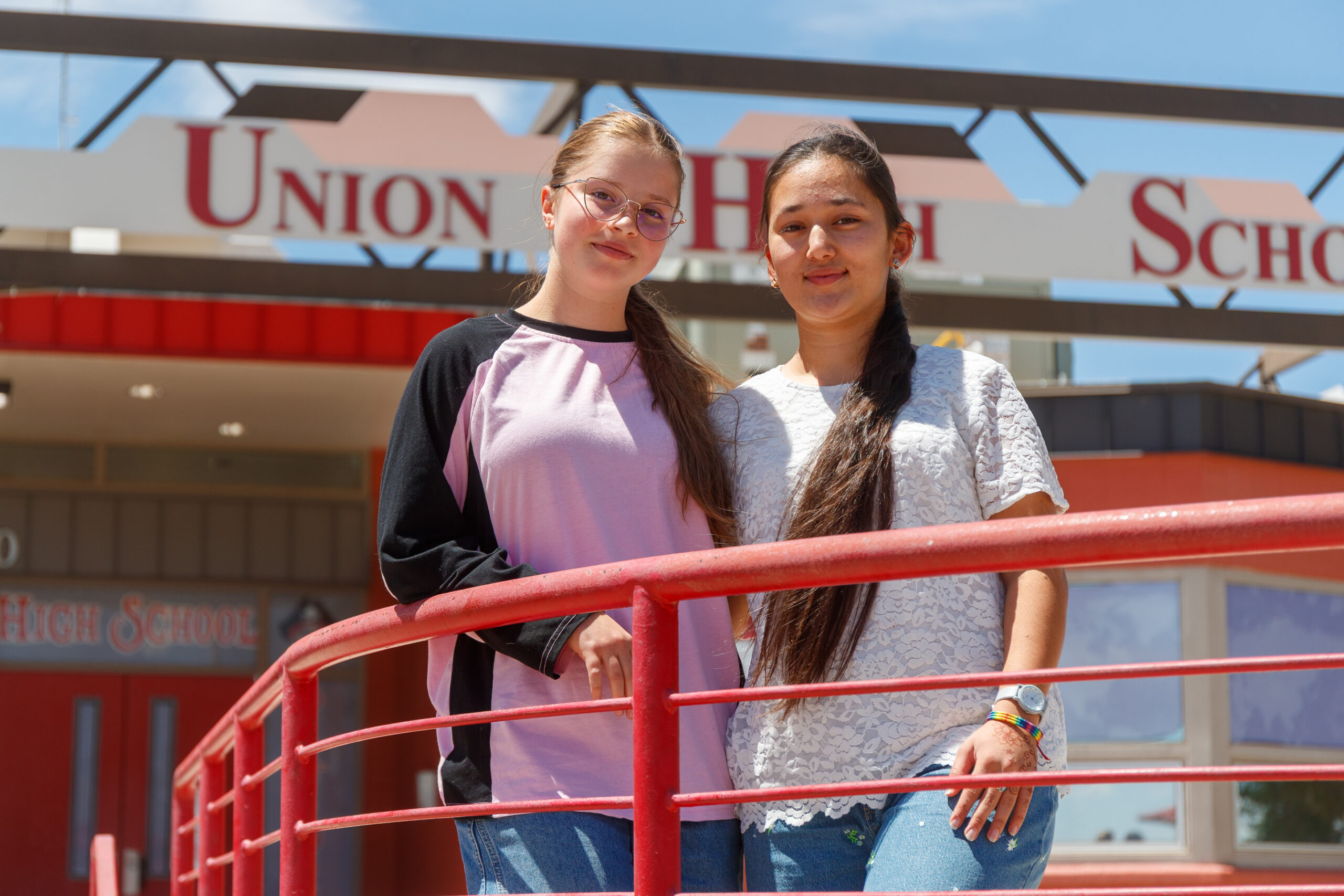
For Guljeren Agajanova, a senior exchange student from Turkmenistan attending Mingus Union High School this year, the biggest cultural shift was the homes.
“In my country, the floors, a simple example, are covered with carpets,” she said. “But here, … there are some carpets, but in very small parts, and they walk with shoes inside the houses.”
She said her school year spent in Arizona was the first time in her life she left Turkmenistan.
“I missed our food,” she said. “It’s so different.”
She commonly eats pilaf, a dish which is mostly rice with meat, like chicken, and carrots. While here, though, she’s found a liking for Mexican and Thai cuisines.
“The best is, for us, Pad Thai,” she said, gesturing to her friend, Tetiana Kolomiiets. “It’s our favorite.”
Kolomiiets is a junior from Ukraine also living in the U.S. for the first time as an exchange student at MUHS.
“The most surprising thing for me, the first thing that I realized when I went out of [the] airport is how hot it is in Arizona,” she said. “Ukraine is way colder than here, especially because it was Phoenix.”
The pair arrived just before school began in mid-August.
Kolomiiets said even just being in the US is an eye opener for the different cultures.
“People are very nice here,” she said. “When you bond with them, you start comparing your cultural things, and they ask a lot of questions because they’re also very curious.”
She’s made a lot of connections here, and is going to miss her friends and host family a lot.
Both are active in a variety of clubs, including Key Club, Track and Field and Interact and STEAM clubs.
One thing “I love about the American schools, they do a bunch of field trips,” Agajanova said.
She said she really liked the trip to Lowell Observatory in Flagstaff, but they’ve also traveled to Los Angeles, Las Vegas, the Grand Canyon and Zion national parks.
With so many activities and events happening at school and in the community, it’s really easy to be involved and meet new people. The cultural emphasis on social life here is different than it is back home, which she said she’ll miss a bit.
“Here, we grow socially,” she said. “But back home, we’re going to grow academically.”
Exchange Program
Both are part of different national exchange programs hosted by the US government.
“One is called the YES program, which is Muslim countries, and the FLEX program is former Soviet Union countries,” exchange coordinator Marcia Goebel said.
The Kennedy-Lugar Youth Exchange and Study was canceled for future years by Trump administration. Both are merit-based programs, with thousands in each respective country applying and only a few dozen being accepted.
Goebel said she’s coordinated schools for kids from Pakistan, India, Bosnia, Yemen and countries in Africa and the former Soviet Union.
“Used to be Russia, but that program was cut from [Russian President Vladimir] Putin,” she said. “So you can see it’s politically tied into places in the world we need to build relationships with. That’s why the program is so wonderful.”
Goebel has been involved with the Program for Academic Exchange for 30 years, beginning in 1996. She said she is sad to see the YES program be cut.
“The FLEX, all I know is we had maybe 80 or 90 kids last year to place – these are coordinators all over the U.S.,” she said. “This year, we got cut to 30 kids for all the coordinators all over the U.S.”
She said the program, which is run by the U.S. State Department, had historically given projects and ideals to have for these students, including at least one volunteer project and activities based on “democracy, cultural diversity, leadership and volunteerism,” Goebel said.
“During November, we had International Education Week,” Agajanova said, “where we had an opportunity to give presentations to our friends at school for a whole week, and when we go back, it’s going to be the same thing.”
Families
“The hardest part of my program is finding the families,” Goebel said. “The kids are great.”
She places kids around four schools between Cottonwood and Flagstaff. She said she wants to have some students at Sedona Red Rock High School, too, but it charges tuition for international exchange students, which the program doesn’t cover.
Agajanova and Kolomiiets began the year with families in Sedona, driving to Cottonwood each morning.
Agajanova switched to a Cottonwood-based family she connected with after arriving in Sedona.
She finds students permanent host families and welcome families.
“A welcome family is six to eight weeks, but what it does is it brings the student into the community so that they make relationships with friends, teachers and people see how awesome they are,” Goebel said.
The program, she said, prefers students to stay with one family the whole year, after the welcome family brings them in. Circumstances can lead to the student needing a second host, though.
On April 28, she said one of the families she had picked out for a student to come next year told her they couldn’t take the student anymore and she is on the lookout for a new family. Contact Goebel at marciagoebel@yahoo.com or (928) 301-9868 if interested.
She said she’d like to get either a welcome family or a host family by the end of May, if possible.