

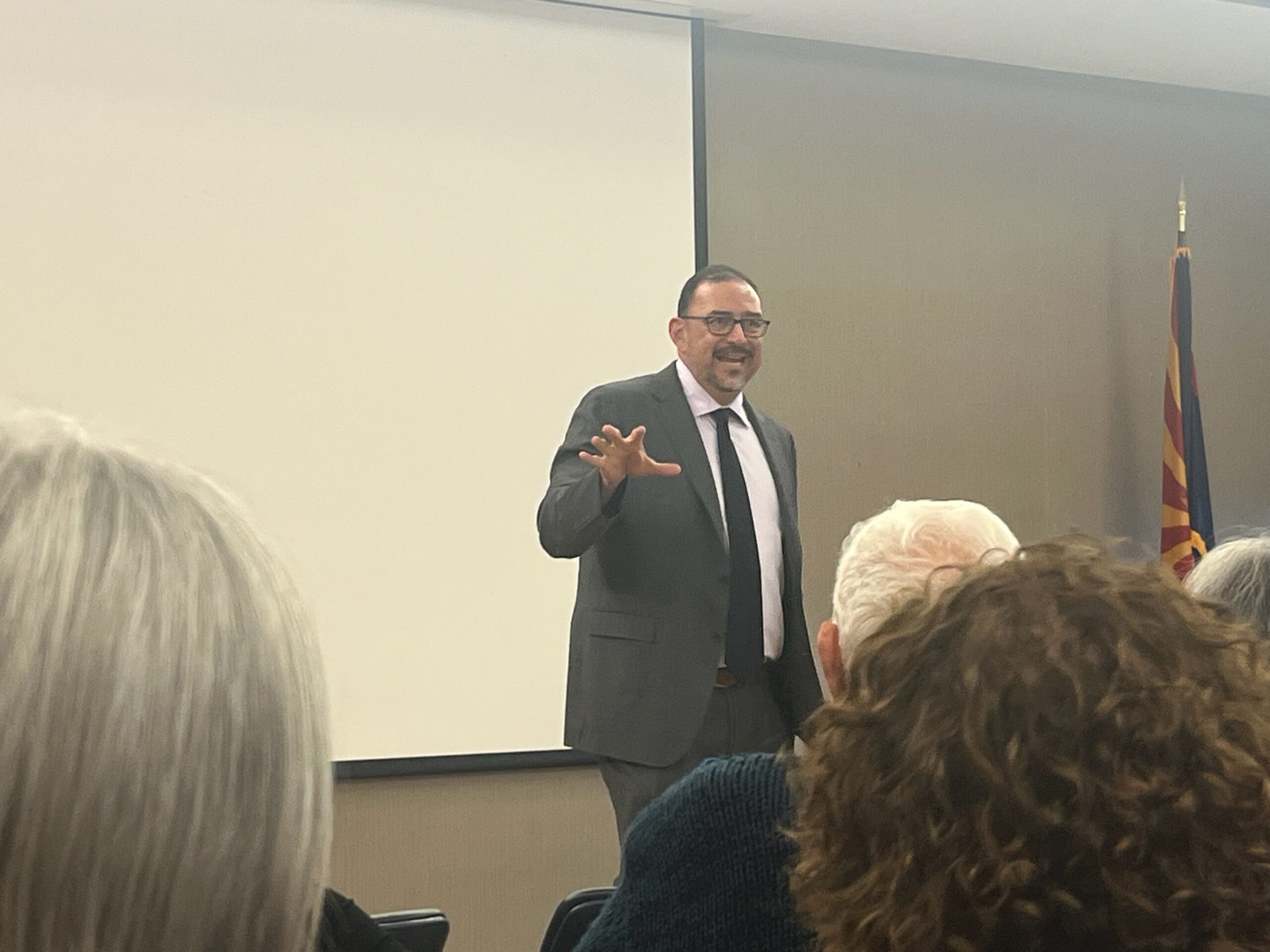
Arizona Secretary of State Adrian Fontes [D] defended early voting and mail-in ballots during a Monday forum at the Cottonwood Recreation Center.
About 50 constituents attended the Feb. 9 event titled “Fighting Voter Suppression Efforts,” hosted by the League of Women Voters of Northern Arizona and Central Yavapai County.
“I’m the 21st secretary of state here in Arizona, and I am the last secretary of state who is [next in line to be governor],” Fontes said. “Because in 2026, we will not only be electing a governor, but that person will be running on a ticket with a lieutenant governor. Arizona created a new executive officer in our last election.”
Proposition 131, which 55% of voters approved in 2022, requires gubernatorial candidates to name their second-in-command, similar to a vice president, shortly after the primary election, with both candidates running on a joint ticket in the November general election.
The primary election has been moved to permanently be the second to last Tuesday in July.
“This year’s Primary Election will take place on Tuesday, July 21,” a city of Sedona press release reads. “The move was needed to allow elections officials more time to conduct election preparations for the general election, including ensuring that military and overseas voters have their ballots in time to participate in the General Election.”
“Immediately upon the signature from [Gov. Katie Hobbs] on that bill, we issued the new deadlines that apply to filing deadlines,” Fontes said. “There’s a lot of shifting that needs to happen. But elections officials across the state had anticipated this… folks were really kind of ready. And as this thing was working its way through the legislature… So there’s not a ton that we need to do now, it’s going to be up to the parties, the candidates, and to a degree, our office and other election offices to make sure the public is fully informed.”
Another potential change Yavapai County voters should anticipate is no text message ballot tracking system in 2026.
“We have introduced a ballot tracking system that we brought to Maricopa [County] … [where] you get a text message when your ballots coming to you [and] when it gets back to the election department,” Fontes said. But “guess what? That’s going away. Unless Yavapai County can figure out how to pay for it themselves. We’ve been paying for it. We don’t have enough money to do it. This cycle.”
Election Bills
Fontes discussed Arizona Senate Bill 1262 sponsored by Arizona State Sen. Priya Sundareshan [D-District 18], the “Voters First Act,” a proposal he and Democratic lawmakers are advancing this session. The measure would restore the Permanent Early Vote List; require the use of vote centers statewide; extend early voting through 5 p.m. on the Monday before an election; ensure early ballots mistakenly returned to the wrong county are counted; and allow continuous ballot collection and processing on Election Day. It would also modernize the 75-foot voter protection zone around drop boxes and voting locations; require participation in the Electronic Registration Information Center, with funding, to maintain voter registration lists; provide at least $1 million in new funding in the Secretary of State’s budget for election IT and cybersecurity; require counties to send ballot text notifications; and allow the Secretary of State and counties to accept private grants for election administration and voter education.
Throughout the evening, Fontes repeatedly referenced the Trump administration, which he labeled an “industry of grievance” stemming from Trump’s denial of the 2020 election results and the Republican response that followed, prompting a lenghtly recount in Maricopa County that validated the election results, awarding Arizona Electorial College votes to Democrat Joe Biden.
2026 Election
Fontes is up for reelection this year and Arizona State Rep. Alexander Kolodin [R-District 3], of Scottsdale, has announced his campaign to unseat him. Additionally, former Arizona Republican Party chairwoman Gina Swoboda filed a statement of interest on Feb. 3 to run for the Republican nomination for secretary of state, though she previously announced plans in October to run for Congressional District 1.
Kolodin, an attorney, authored House Concurrent Resolution 2001 that may be going to voters for approval in November would do away with the active early voter list that automatically sends ballots to voters and end early ballot drop-offs on the Friday before an election, along with several other changes. HCR 2001 passed out of the House along party lines 32-27 on Feb. 9, where it now goes to the Senate.
“Arizonans are done with excuses, delays, and chaos in our elections,” Kolodin wrote in a press release. “Elections should be decided by citizens — not by disorder and not by foreign money. HCR 2001 puts clear rules in the Constitution: citizens vote, voters show ID, foreign money stays out, ballots are counted on time, and Election Day means Election Day. Voter ID is non-negotiable.”
Republican election measures drew sharp criticism from Fontes during the evening, including the SAVE America Act that the U.S. House of Representatives passed along party lines 218-213 the following day on Feb. 11. The bill would nationally require a valid photo identification before voters can cast ballots, and absentee and mail-in voters would need to attach a copy of their ID to their mail-in ballot.
“I’m proud to support the SAVE America Act, which requires voter ID to participate in our electoral process,” U.S. Rep. Eli Crane [R-District 2], who represents Cottonwood, wrote in a press release. “The American people overwhelmingly support this concept, and Congress should waste no time in making this a reality. By shoring up vulnerabilities in our system, we prevent ineligible votes from diluting the voice of American citizens.”
Crane also cited concerns about non-citizens voting in his announcement.
The conservative Heritage Foundation has documented 1,620 confirmed cases of voter fraud nationwide since 1982. Over that same period, more than 1.3 billion presidential ballots have been cast across 11 election cycles, according to data from the American Presidency Project at University of California Santa Barbara.
“The SAVE Act is a disaster,” Fontes said. “From the signing of the SAVE act,” if it passes “we’ve got to turn over our voter rolls. … Look, if you’re an election lawyer, you’re loving this because your billables are through the roof.”
“What we’re going to end up doing is kicking a whole bunch of people off the voter rolls if the Save Act passes,” Fontes said and claimed that, if the SAVE Act passes, Republican woman voters “will suffer the most.
“Because what you have are a lot of folks across America in rural communities who may not have access to their birth documents, who may not have access to what they need to prove that their married name is not their birth name or their birth name is their married name.”
“If there’s any advice I can give you and how you can make a big difference,” Fontes said in closing. “Here it is, particularly as to worries about what might happen on election day, please do what was suggested. Vote early. Vote by Mail.”


