


“I woke up early, ready to help with Verde Valley School’s commencement,” she wrote. “Do you know how it is when you feel off? I felt that way, still not having entirely shaken off the bad feelings from the Los Angeles trip.
“I had a dull throb behind my left eye, which I thought might be helped by drinking water or sleeping it off. The throb didn’t fade. It grew. Loud and insistent. Like a drumbeat echoing through my skull, each pulse sharper than the last.”
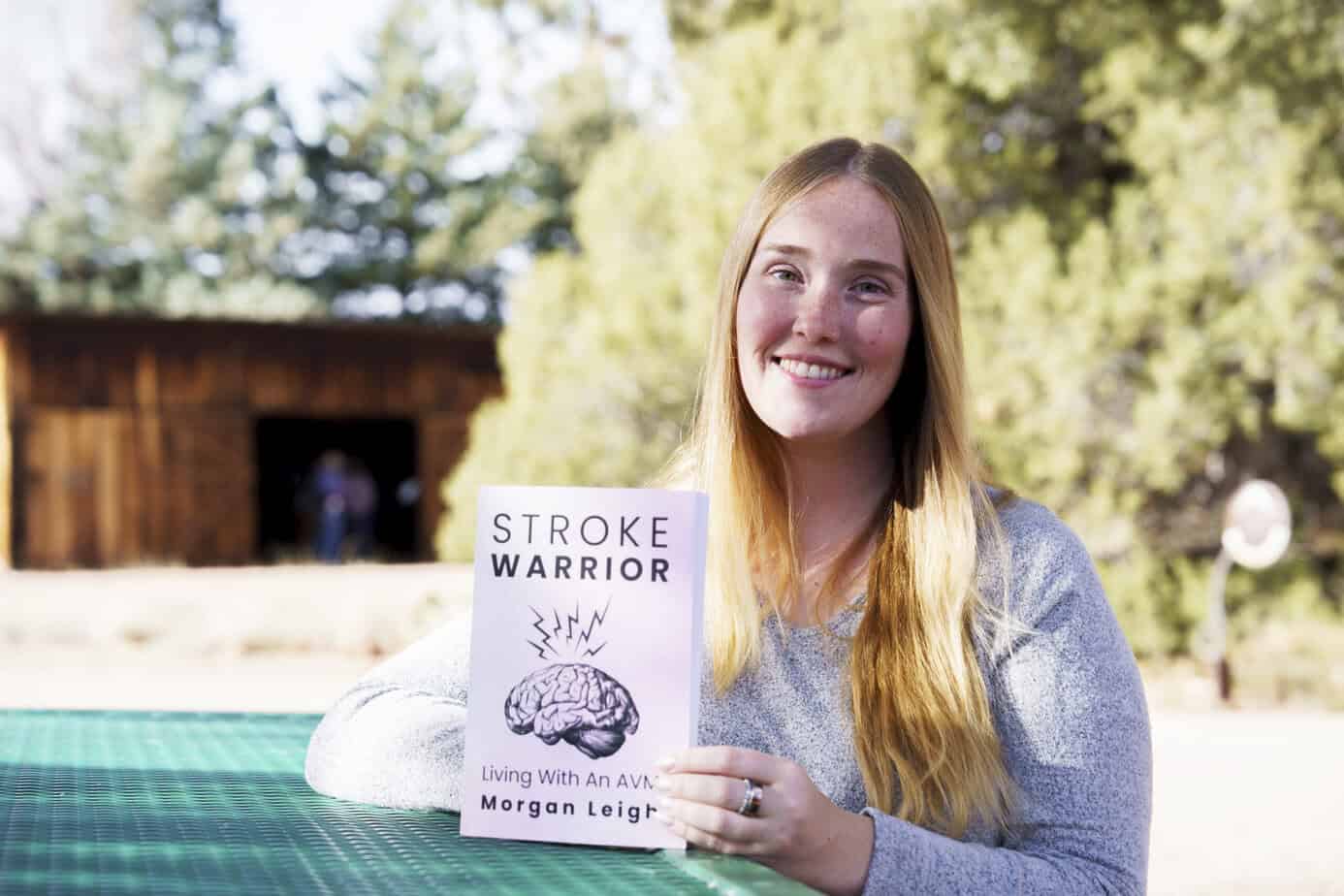
Barely four years later, Morgan Leigh Bailey, 27, manages the Sedona Heritage Museum gift shop. But by experience, she is a stroke survivor and is now the author — under the pen name Morgan Leigh — of “Stroke Warrior: Living With An AVM” a new part-memoir, part-survival guide available at the museum.
With arteriovenous malformation, or AVM, the blood vessels in the brain are tangled, causing irregular connections between arteries and veins, according to the Mayo Clinic. The book’s October release coincided with AVM Awareness Month.
“She gets up every morning excited to face the day and see what she can achieve to experience everything,” SHM Executive Director Nate Meyers said. “She finds joy in everything and in small things. She and I talk often about food that we eat when we go on vacation and we share food pictures with each other, because that’s one of those things she just loves. I think that’s where she finds her optimism — in looking ahead to each new day and what 2026 adventures she’s going to encounter.”
Over the last year, Leigh said she has been focused on improving her recovery through her physical, occupational and speech therapy and chalking up progress where she can.
“I find victories in the smallest things like opening my hand a centimeter more than I did yesterday,” Leigh said. “Those small victories excite me, because I experience them every day, and that’s amazing.”
Leigh said she started writing the book as a memoir in 2020 before “the day [her] brain exploded” as she describes it but adopted it to include her new reality.
“When I first was in the hospital, I would say I have to go to the bathroom, [but] I meant I’m hungry, so my words were all jumbled up,” Leigh said. “My aphasia has definitely gotten better. A loss has been my tone or my spasticity in my right side. I wish it would get better. Another win would be that I am alive, that I’m so grateful to be here, to be on this Earth. Another loss has been … to grieve this person I thought I was going to be. But another win would be that I found this new version of me that I am so proud of.”
This “new version” of Leigh is a departure from the one that was planning to attend law school. Adding, her focus has shifted toward becoming an inspirational speaker for those currently navigating the early, difficult stages of recovery in hospitals and rehab centers. She has already begun this work by visiting stroke support groups at Barrow Neurological Institute.
“What I would love to do in the future is to get the chance to travel the country and speak on strokes [by] going to rehab centers, going to hospitals, going to schools, what it means to have a stroke at 22 years old,” Leigh said.