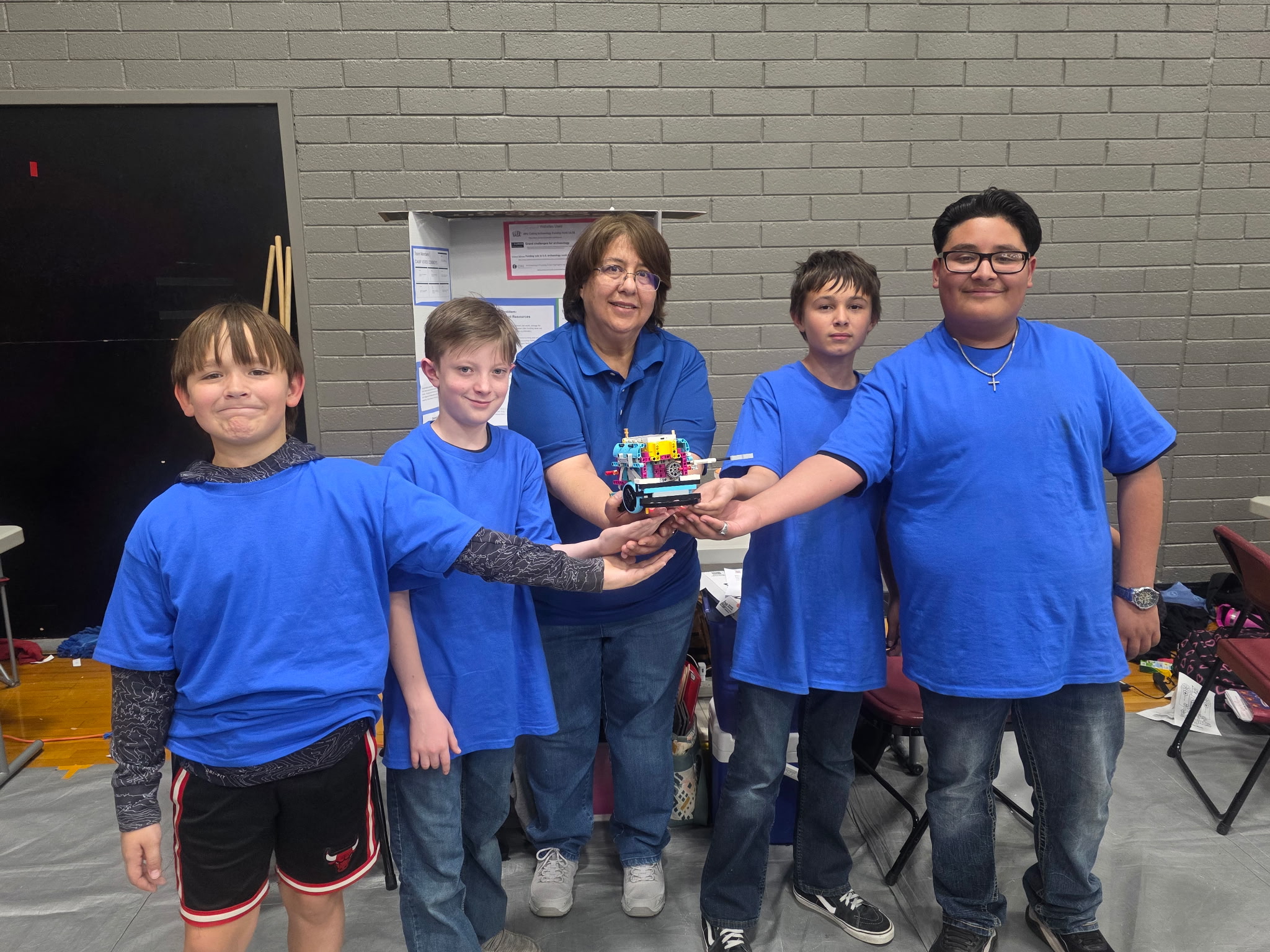
While the Camp Verde Middle School Robotics Team is mostly made up of rookies and the members didn’t expect to place well at their Dec. 6 tournament in Flagstaff, its robot ended up earning third.
“There are about 25 to 35 teams each year,” robotics coach Barbra Robles wrote after the tournament. “The top six or seven advance to the next round, which is the state tournament held at an [Arizona State University] campus. There is potential for a team to advance to Nationals then to World competition.”
The organization, For Inspiration and Recognition of Science and Technology, hosts Lego League for elementary and middle school students, as well as its Tech Challenge, for middle and high school students, and larger Robotics Competition, for exclusively high school students.
The robot section is only one third of the score needed to advance. While the Cowboys’ robot placed well, the other sections were not high enough to advance to the next stage.
The other sections included core values like team work and communication throughout the tournament and creating a project related to the year’s theme, which this year was “Unearthed” based on archeology, and presenting that project to a board of judges.
“Our innovation project was based on a great idea, but presenting those ideas in front of judges can be a daunting task to a new team,” Robles wrote. “Well we know what to work on next year. The team needed to experience that part of the judging to better understand the task.”
The team’s presentation was attempting to address funding shortages for archeological excavations. Its solution? To sell an archeology-based video game that acts like Sid Meier’s “Civilization” to raise funds that would go directly to archeological societies.
The robotics portion is what the members spend most of their time on, however.
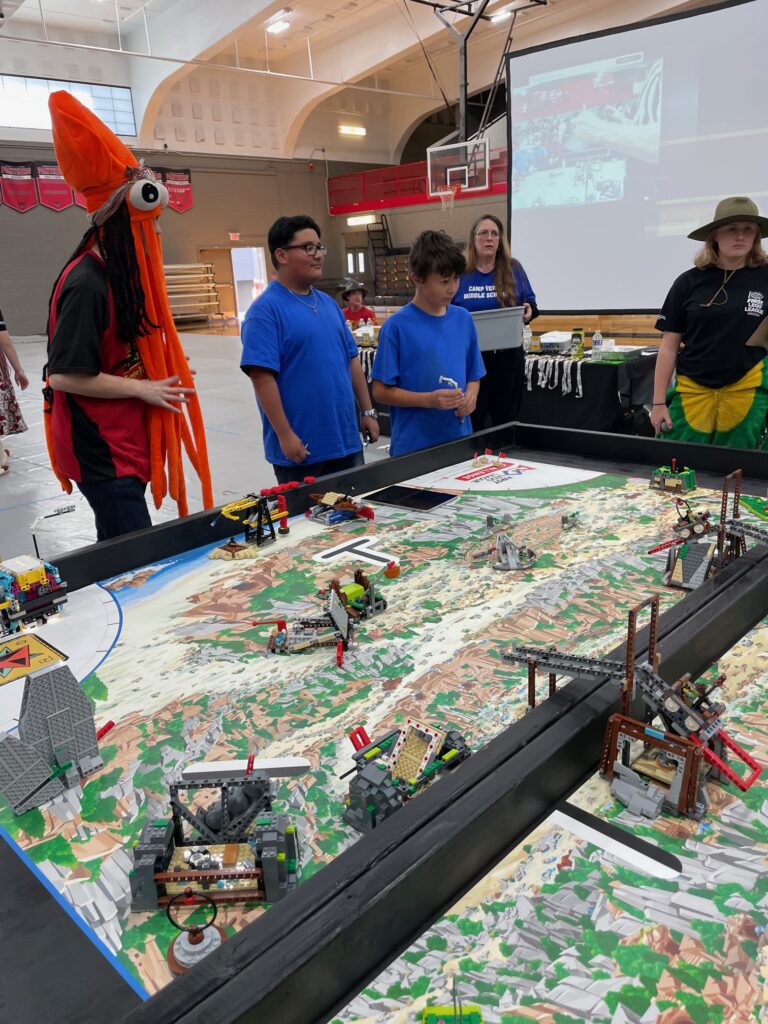
The Cowboys build its robots with Lego bricks. The FIRST Lego League field is a table about 4 feet by 8 feet with 14 Lego constructions scattered throughout. The goal is for the robot to interact with red mechanisms attached to each Lego structure.
The red mechanisms would do different things: One would uncover a hidden boat. Another would recover old maps of the area. Another would brush the surface to uncover buried artifacts.
Members created interchangeable parts and removed and attached different pieces as needed throughout the match. The robot has to do everything by itself, though. The human players can only interact with the robot when it’s in the designated areas and only to exchange a part or two.
Alberto Lazande, a seventh grader, said the team tried to do as many of the tasks as possible in the two-and-a-half minute game. The tough part about that is they only had about 18 hours of practice overall before the tournament.
“We only meet an hour-and-ahalf a week,” Robles said.
The club can’t meet after school because of transportation issues, so it happens during their fifth period, which Lazande said was a plus for being on the team.
Camp Verde Middle School students are required to take a coding class, Robles said, which works hand in hand with being on the robotics team.
“They program it with a kind of a scratch base block program. So these guys haven’t been in my class yet for scratch,” she said, gesturing to the two sixth-graders who went to the tournament before gesturing to the seventh-graders.
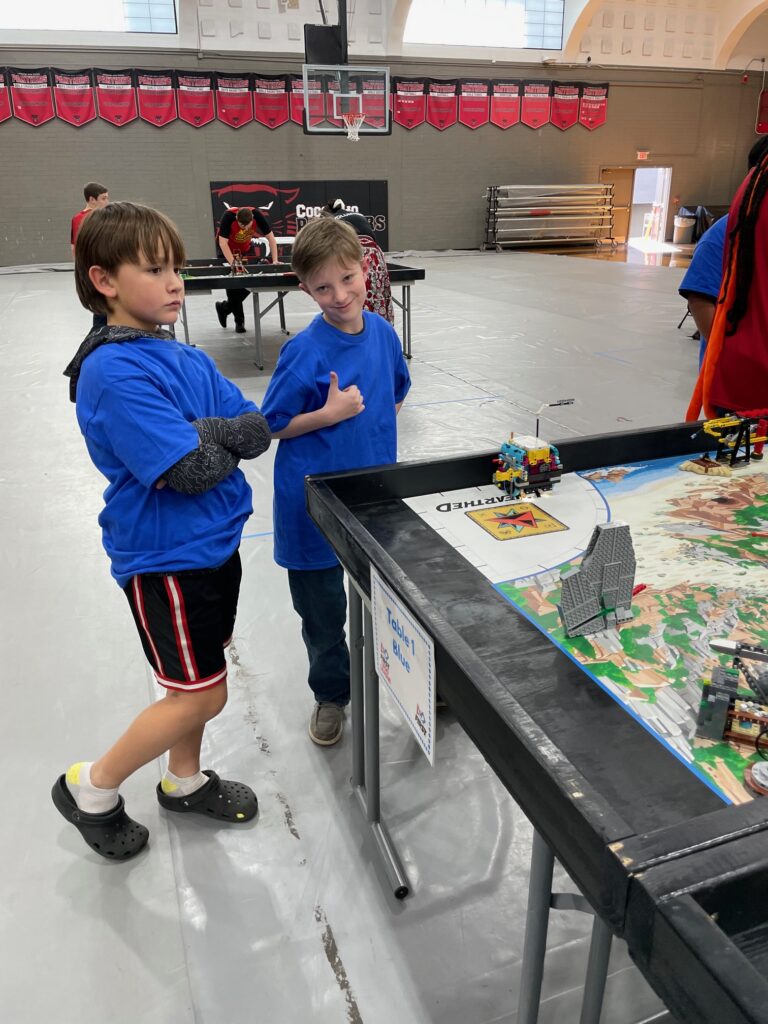
“But they have, and the other kids had, … probably why they did so well with the robot, they had more experience. Because the school has been doing programming for a couple years.”
The team, which is composed of seven students ages 9 to 14,had only four students able to go to the tournament, Lazande, seventh grader Malaki Martin and sixth-graders Maximo Frister and Ryker Zellner.
Lazande, the most robotics experienced person on the team, joined when he was in fourth grade. The rest his teammates began this year.
“I thought it was going to be horrible,” Martin said. He was “forced” to come by Lazande, who’s one of his close friends.
Now, Martin plans on continuing next year because he’s had so much fun. Out of all the fun he’s had, though, he said drinking the coffee was his favorite part of being at the tournament.
“I’ve just always been interested by tech,” Zellner said.
Oak Creek Elementary and Mountain View Preparatory both have robotics teams that host scrimmages in the spring semester, Robles said. They aren’t sanctioned games, so won’t mean anything for placing through FLL, but do give the students practice.
“We’re going to go to more scrimmages this time,” Robles said.
While the team has been around a while, this is Robles’ first year as coach. She previously worked at West Sedona School before moving to Camp Verde.