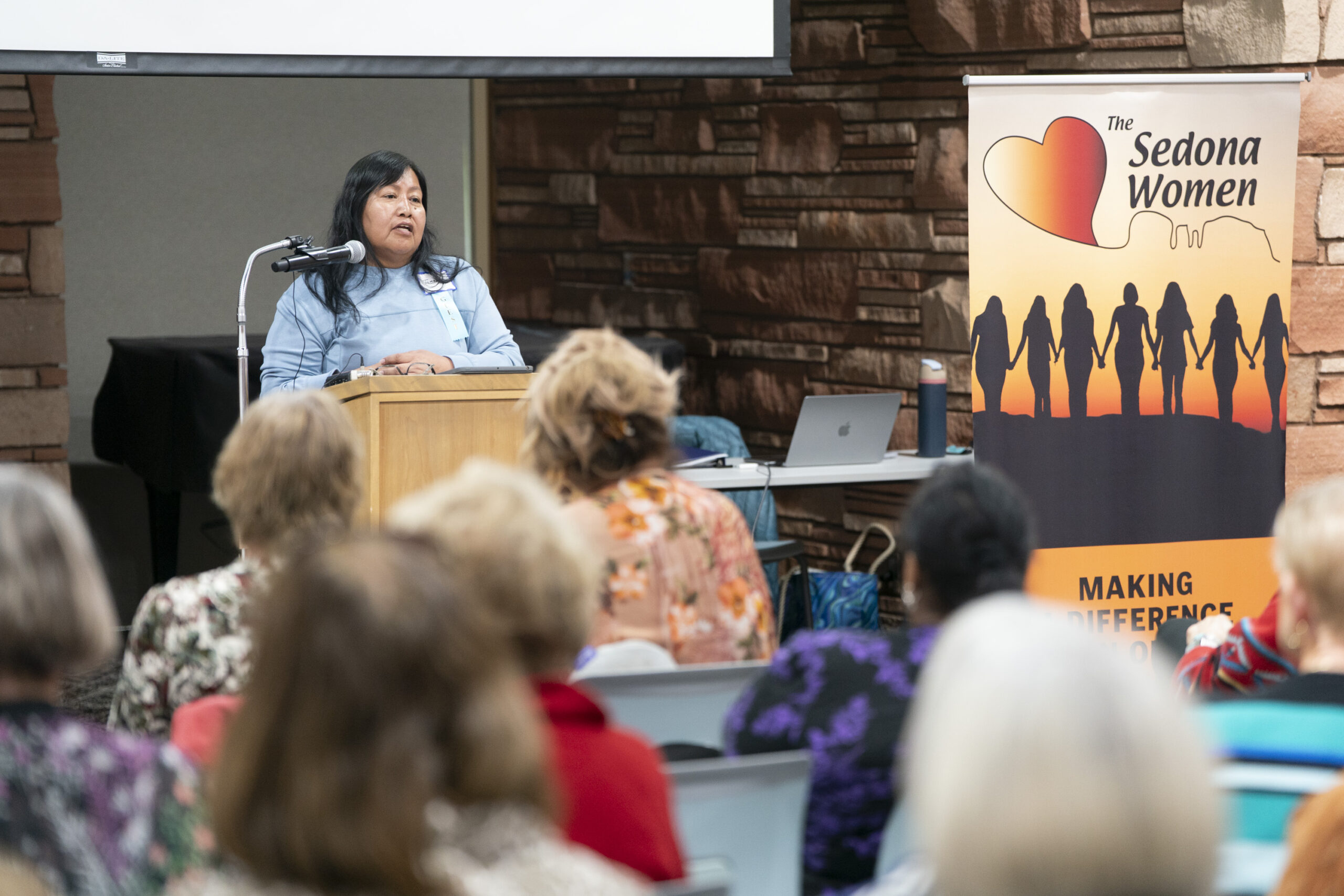
Former Yavapai-Apache Nation Tribal Councilwoman Thomasene Cardona, 55, stopped by The Sedona Women’s regular meeting at Sedona Public Library on Thursday, Nov. 13.
She shared news about the launch of the Yavapai Land and Cultural Collective project, which is scheduled for a formal unveiling on Saturday, Jan. 17, from 10 a.m. to noon at the Kwail Heights Gymnasium, 1775 Hawk Hollow Way in Clarkdale.
“The project is really about a return to Yavapai identity, and its primary focus is to reintroduce the Yavapai tribal community to the different sacred areas that we had access to prior to the forced march [in 1875], and to utilize the language in that process and reconnect with the land through the plants and the different ceremonies that we held in the area,” Cardona said.
To support this effort, Cardona recently received a $7,000 Maxwell-Lutz Community Impact Award from Northern Arizona University, which funds research to advance environmental sustainability and the health cultures.
“The collective stems from my personal experience,” Cardona said. “I grew up in Clarkdale and lived in the community until I was about 38, and then I moved to the
Camp Verde area. I’ve been here in Camp Verde for about 20 years now. It’s really about community and everything it took from our return to today in recognizing the challenges our people have faced, but also the importance of maintaining our language, our culture and the different ceremonies we carried out for millennia prior to that forced march.”
Cardona said the project will have the support of the tribe, and is not yet registered as a 501(c)(3) nonprofit. She explained that a preliminary request for land has been made, which is part of the group’s broader vision for creating a community garden focused on the traditional ethnobotany of the Yavapai people at a to be determined location in Clarkdale.
Additionally broader discussions within the Yavapai community also have to occur about what should be grown in the garden.
“There’s this idea that was shared by my uncle, Vincent Randall, and that was mesquite or wild onions and wild spinach, those things were never to be picked up and replanted somewhere else,” Cardona said. “These are values that the community will have to decide for themselves. It could be that the people want to … just going out and harvest those plants the traditional way. [But] I feel like we have a responsibility to ensure that we are protecting the plants, protecting the land and our food ways, and if that also means bringing them into a community garden, then I feel that that’s a big, a big piece of where we are today as [the] Yavapai people.”
Among the partnerships Cardona has formed in creating the collective are with Peggy Chaikin of the Northern Arizona Climate Change Alliance, Garden of Life and Keep Sedona Beautiful.
“KSB has a committee called Indigenous Peoples Awareness Committee, and Thomasene and I are co-chairs,” KSB president Carla Williams wrote. “I helped her develop the initial Project Execution Plan, defining the scope, schedule and budget, and the KSB committee members will continue to support Thomasene throughout the execution phase.”
The committee, formed about a year and a half ago, meets monthly to learn about local indigenous communities. Members visit reservations, attend events to listen to indigenous speakers and occasionally volunteer, including helping with food when needed.
“We [also] have a new native plant garden at Keep Sedona Beautiful, and it could dovetail nicely with Thomasene’s ideas for her project and the garden she plans to create,” Williams said. “For example, we’re already bringing schoolchildren to our garden, so if that becomes an ongoing program, it could eventually connect with her garden as well … and since we have this committee, we also have volunteers who are willing and able to help.”
In the near term, Cardona said among the collective’s goals are create a social media presence and to find 10 tribal members in the Clarkdale community who are interested in backyard gardening and learn the traditional Yavapai names for several ancestral foraging locations.
“Even though we know the names of these areas as Clarkdale, Camp Verde, Cottonwood, there’s still the homeland of the Yavapai people, and it is important for that recognition to be given. Because it hasn’t changed,” Cardona said. “We are still here. We are still contributing, and we still have a cultural way of life that we want to maintain, and that’s important to our future.”
The Sedona Women meet every second Thursday from September through May at the main branch of the Community Library in Sedona. For more information, visit thesedonawomen.com or email thesedonawomen@gmail.com.