
The Clarkdale Town Council adopted an ordinance at its regular meeting on Wednesday, Nov. 12, amending the town’s zoning code to meet compliance for House Bill 2447.
House Bill 2447 was signed into law by Gov. Katie Hobbs [D] on March 31, and requires towns and cities to conduct administrative review and approval of site plans, development plans, land divisions, lot line adjustments, lot ties, preliminary plats, final plats and plat amendments without a public hearing. It also requires town and city staff to review and approve design review plans based on objective standards without a public hearing*.
The process for approving preliminary and final plats in Clarkdale currently requires public hearings before the Planning Commission and Town Council. Staff already approves some land divisions administratively, such as minor land divisions of three lots or fewer and lot line adjustments.
With the current process, the Town Council must approve plats and land divisions based on whether they meet zoning code requirements and adopted standards or not, or they could be subject to legal action by the applicant. Shifting this responsibility to staff does not change the ultimate outcome, but eliminates the process that the public relies on to be informed about changes that may affect the community.
To comply with the bill’s effective date of Wednesday, Dec. 31, Clarkdale is updating two chapters of the town’s zoning code: Chapter 11, Design Review and Site Plan Review, and Chapter 12, Subdivision Regulations.
To amend the design review, staff has eliminated all terms that are subjective, such as references to compatibility and relationship to adjacent structures. This does not apply to the Historic Preservation ordinance. Properties that choose to opt in to the Historic Preservation District will still go to the Historic Preservation Commission for review, and those that do not opt in will be reviewed by the Planning Commission.
The public can still comment and share their concerns with staff, just no longer in a public setting. In order to maintain these opportunities for the public to be informed about upcoming projects, the town will post projects on the town’s website, notifications of new projects will be posted on the town’s Facebook page, staff updates will be included in the weekly e-newsletter, and staff will update the Planning Commission and the Town Council when applications are received and approved.
The council held a public hearing to take comments regarding the ordinance. No members of the public spoke.
Assistant Town Manager Ruth Mayday said the role of the Planning Commission has not been eliminated. Members will still review things like rezonings and conditional use permits.
“The disappointment for our community is pretty huge because we want to participate,” Mayor Robyn Prud’homme-Bauer said. “We want to help shape our town.”
She mentioned opportunities to focus on what council town can do, such as strengthening the town’s General Plan and other guidelines that they give to staff.
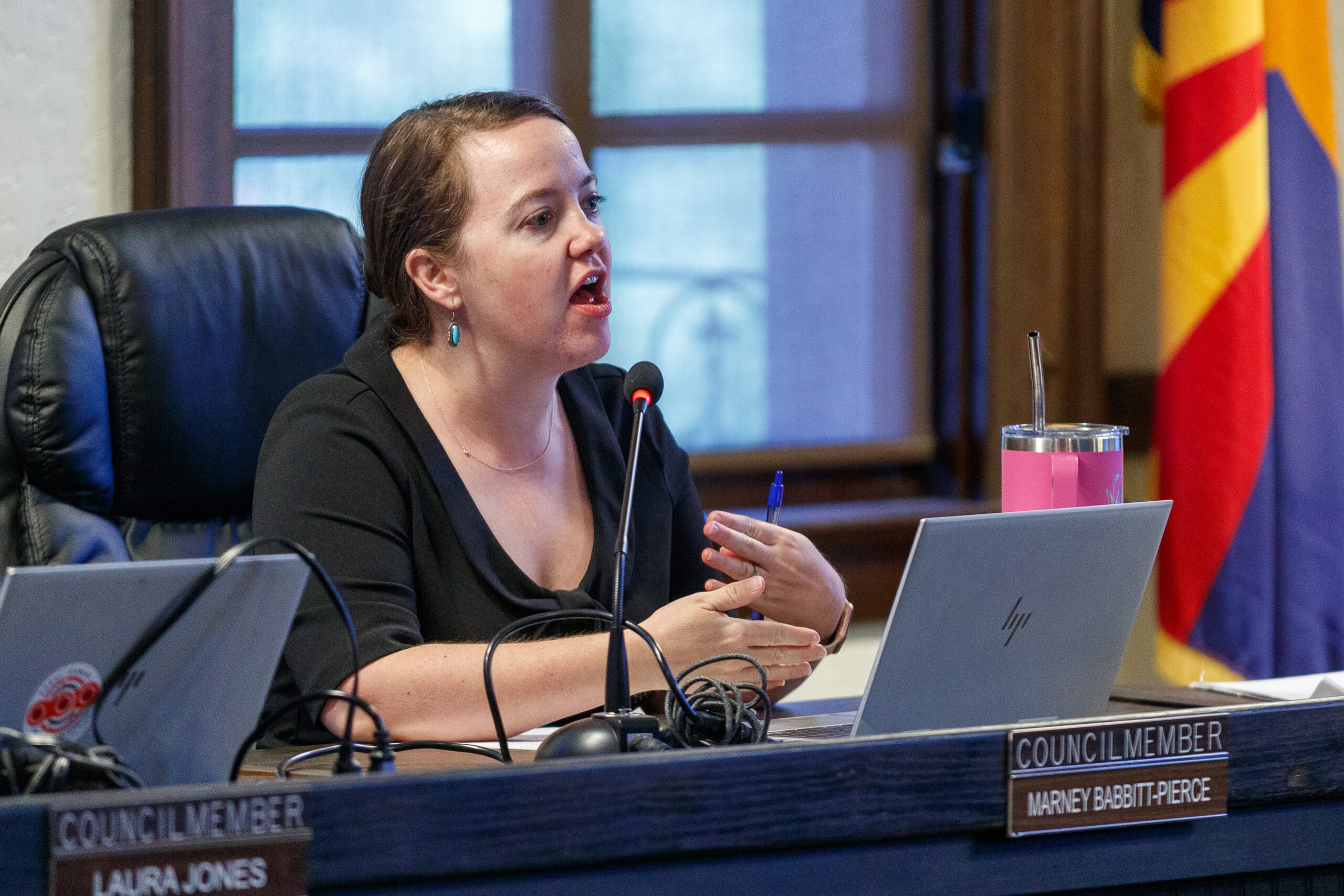
Councilwoman Marney Babbitt-Pierce stated that she’s disappointed that the legislature has taken away local control, but is grateful for the ways staff has presented to ensure the community stays informed.
The ordinance passed in a 4-1 vote with Babbitt-Pierce as the opposing vote.
Correction:
This story originally stated “House Bill 2447 was signed into law by Gov. Katie Hobbs [D] on March 31, and requires towns, cities and counties to conduct administrative review and approval of site plans, development plans, land divisions, lot line adjustments, lot ties, preliminary plats, final plats and plat amendments without a public hearing. It also requires town, city and county staff to review and approve design review plans based on objective standards without a public hearing.”
House Bill 2447 does not apply to counties and the reference was erroneously added by the editors.