
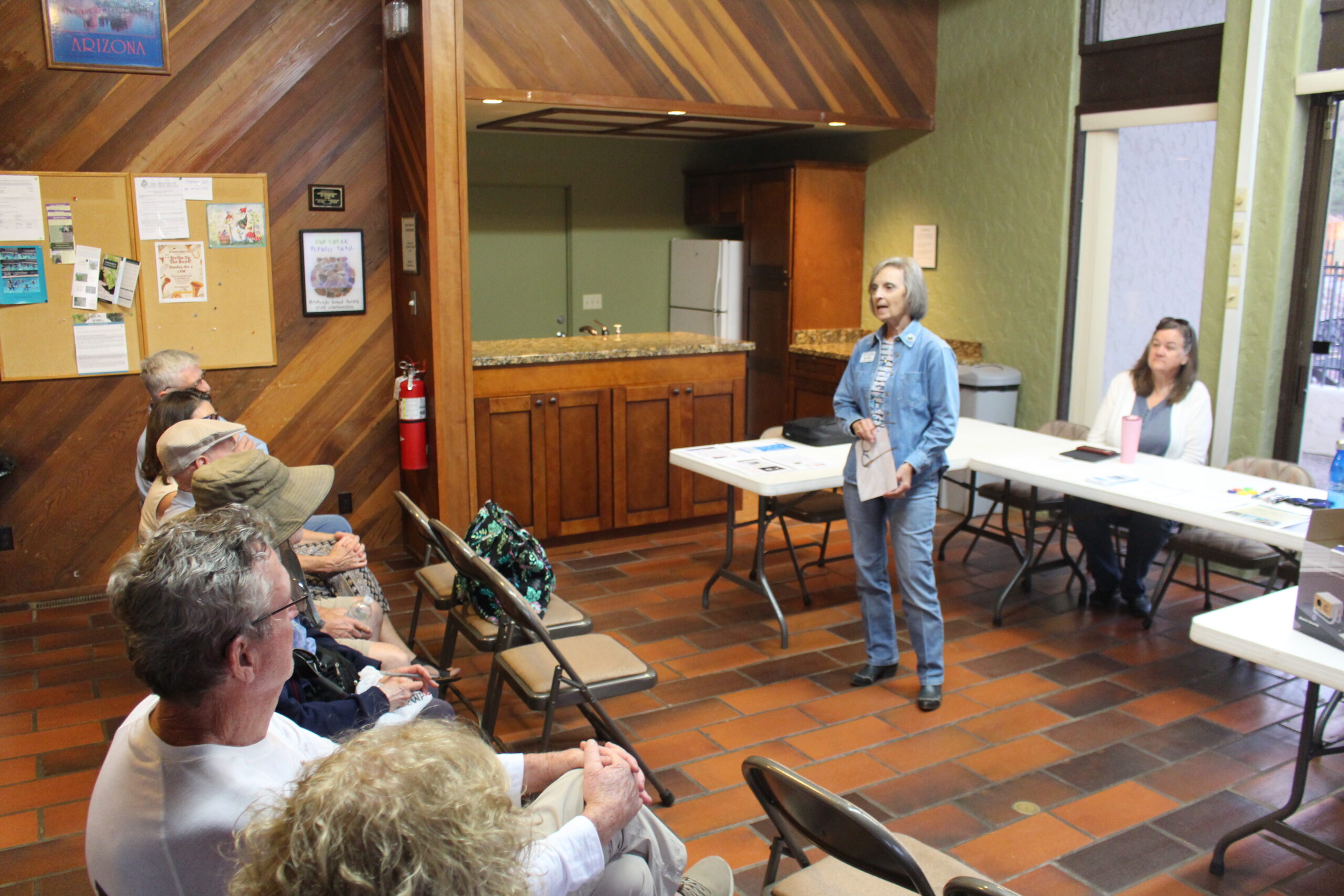
Yavapai County Supervisor Dee Jenkins [R-District 2] hosted a County Town Hall on Sept. 29 at the Oak Creek Valley Club House in Cornville with about a dozen residents and representatives from Yavapai County Sheriff’s Office, Development Services, Yavapai County Flood Control District, Yavapai County Emergency Management and the Verde Valley Fire District, which discussed its $15.5 million General Obligation Bond going before voters.
“Typically, my boss,” Yavapai County Emergency Manager Ashley Ahlquist “would be out here, but she and a couple of other members of our staff are deployed to Globe to help out with starting the recovery process with their flooding,” Deputy Emergency Manager Jon Jones said.
Flash flooding hit the Globe and Miami region on Sept. 26 and left at least three people dead in its wake. Arizona Gov. Katie Hobbs [D] declared a State of Emergency for Gila County the following day.
Jones and YCSO Public Affairs Coordinator Steve Brazell focused largely on disaster preparedness for residents. One key step is registering for the county’s new emergency alert system, Smart911/Rave. Brazell said the transition from the previous Everbridge system should be completed within the next two weeks.
“The last couple of years we’ve been on Everbridge. Now we’re going to one that’s getting standardized [with] a lot of agencies over the state. [The] Arizona legislature has made that possible because they want more cohesion,” Brazell said. “If you’re on Everbridge, which is our current system, then two things: It should automatically transfer your information to Smart911/Rave.”
Users can anticipate an email alerting them of the changeover, and their data should automatically carry over to the new alert system. However, residents may receive an alert from Everbridge explaining how to change over to the new system.
The county’s Know Your Zone system is unaffected by the change, and residents are encouraged to visit protect.genasys.com to learn what zones they are in ahead of an emergency.
“To register, you can text the phrase ‘alertYAVAPAI’ to 78015 and follow the link to sign up, or go to smart911.com,” a YCSO pamphlet reads. “It only takes a few minutes. Do it today.”
YCSO Lt. Chuck Owens, who was promoted in July, also updated residents about the sheriff’s operations around Cornville.
Sheriff David Rhodes cited Owens’ “work ethic, ability to get the job done, and steady hand of leadership. It’s important to have the right people in the right positions, and he had universal support when it came to this promotion,” according to a YCSO press release announcing the promotion of the 28-year military veteran.
Residents praised YCSO during the meeting for enforcement details in Willow Point in Oak Creek Valley, which has had a deluge of campers similar to Bill Grey Road on the edge of Cottonwood. Owens said finding a tow truck company to haul vehicles out of that area has been a challenge for YCSO enforcement “because if they [are] towing those vehicles, they [are] covering the cost of it, because nobody’s coming back to get those vehicles.”
While the U.S. Forest Service has paid to remove “about 15 vehicles” from Willow Point, several vehicles in that area remain, along with a recreation vehicle that has been warned.
Cornville residents raised concerns about improving emergency egress, asking which department to contact to find another way out of Cornville in the event of an emergency.
Before beginning his presentation on Yavapai County’s Zoning Code Update with Roger Eastman of Logan Simpson, an environmental services firm based in Tempe, Development Services Director Jeremy Dye said he would look into the issue.
“The zoning ordinance was adopted by the county in 1968, and it hasn’t really been updated since then,” Dye said. “We’ve updated portions of it here and portions of it there, so we kind of have this patchwork quilt that we’ve put together over the last 56, 57 years. Now we’re doing a comprehensive update.”
The process is expected to take the next few years, with the goal of adopting the new ordinance by late 2027 — milestones in the process include a housing needs assessment and a market analysis and assessment report.
The project’s objectives are to “develop a new state-of-the-art Zoning Code, Subdivision Regulations and Zoning Map; to create codes that are user friendly, so that it is better organized and includes tables and illustrations;” and to ensure codes are compliant with state and federal laws, according to the project summary.
“Yavapai County is special. We need to preserve it, and we need to accommodate growth,” Eastman said. “However, there was no clear consensus on how to manage growth … The Board of Supervisors will have a tricky job there, listening to the public and trying to figure out the right approaches to navigate those two competing desires.”
Dye said the new Section 603 Outdoor Lighting Standards, which should reduce light pollution, went into effect on July 18 after being approved by a 4-1 vote by the board on June 18, which Vice Chairman Brooks Compton [R-District 1] opposed.
For more information on the County Zoning Code Update, visit the Yavapai County Development Services website.
Director of the Yavapai County Flood Control District Lynn Whitman updated the residents on the very early stages of efforts to construct a detention pond and groundwater recharge project upstream of Cornville but said, “we’re a long way from approval.”
Volunteering
District 2 is also looking for two people to serve on the Food Safety Industrial Council. Meetings take place monthly on the second Monday of the month at the Environmental Health Office in Prescott. Those interested in serving should contact Yavapai County Cooperative Extension Program Coordinator Tracey Waters at twaters@arizona.edu or (928) 445-6590.
Bond
VVFD staff were on hand to field questions related to its General Obligation Bond, the first phase of which, if passed, would go out in March in the amount of $10 million — of which $7 million would be for the construction of Station 36, $2 million for communications upgrades to address the radio dead zone that Cornville is in, and $1 million for other projects.
The second phase, if passed, would be for $5.5 million in FY27, including $3 million in health and safety improvements for Station 31 and $2 million for the same improvements for Station 32; Phase 2 would also include $500,000 in contingency.