

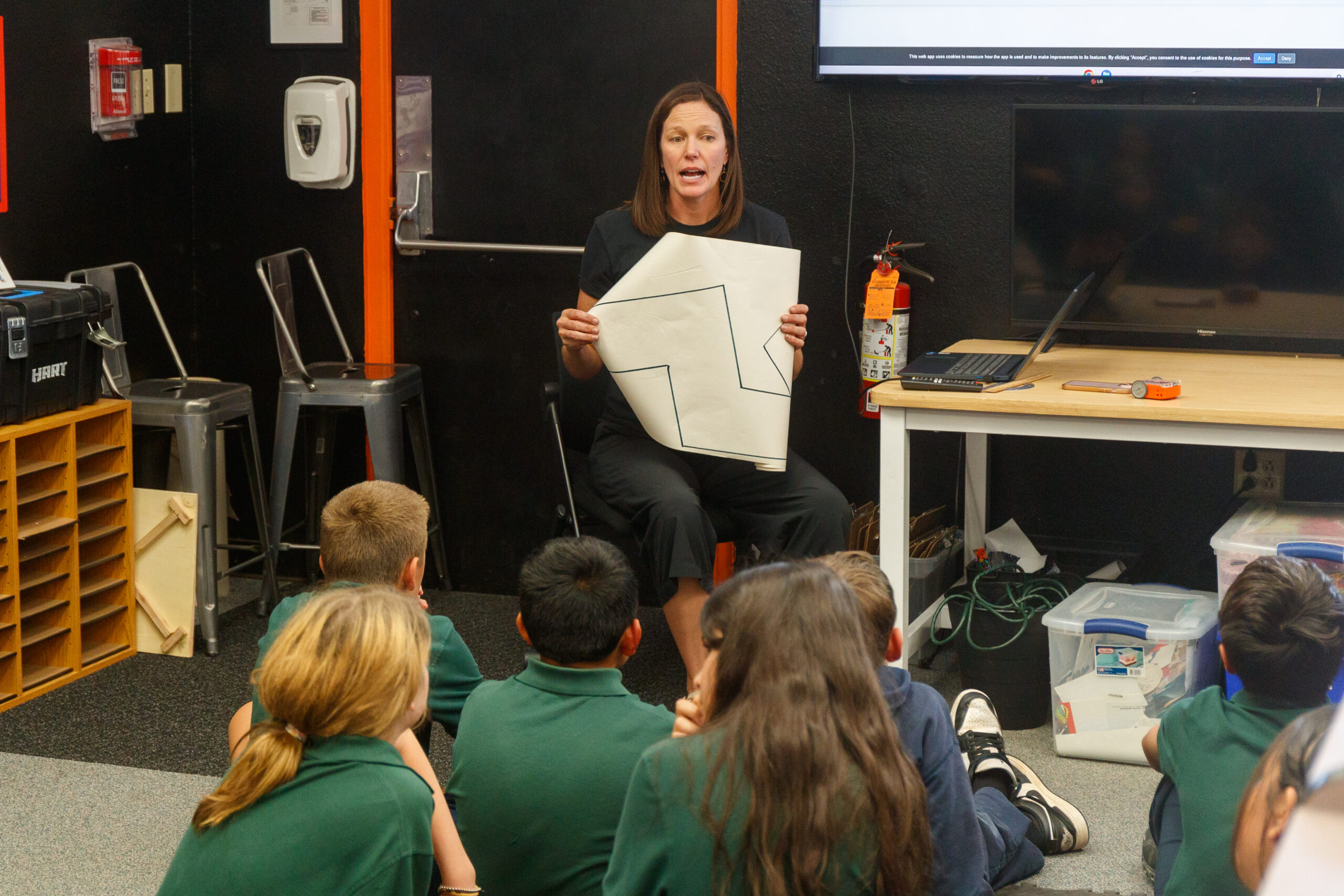
Eleven seventh-graders scrambled across a room, ignoring the simple machines and educational materials to focus on one goal: To program a robot to follow a path with sharp angles printed on a large sheet of paper.
“They’re using block coating, which is a good way to introduce coding to their seventh-graders,” Science Vortex Executive Director Laurie Altringer said. “So they’re using measurement, metric systems, angles and basic problem solving when their code is wrong to get their Edison robot through.”
The Edison robot was a small orange block with two wheels in the back. A successful runthrough came with the promise of M&Ms.
The Science Vortex in Cottonwood helped about 8,000 kids overall from the 2024-2025 school year, Altringer said.
This year, the organization plans to expand even further. Altringer said she helps field trips like this one about three to eight times a week. Generally, these trips are made up of students from the Verde Valley.
Camp Verde
Altringer said she is extremely involved in STEAM education throughout the Verde Valley.
“We’re going have a Science Vortex STEAM club at Camp Verde Middle School, starting in two weeks, every Monday during their lunch period,” Altringer said during the Sept. 16 seventh-grade field trip to the vortex.
In Camp Verde, school is on a four-day schedule. On Fridays, science camps take place at the library every week since the beginning of September.
Usually Camp Verde Elementary School teacher Denise Meyer oversees these. The camps are often about two hours long, which helps Meyer take the students, usually between grades one and six, through more complicated topics.
“Laurie did the third one, and I believe she brought Edison robots for them to play with, to kind of figure out and program, do some coding,” she said on Sept. 23. “This week I’m going to do AlkaSeltzer rockets. So … we’re going to use water and AlkaSeltzer, and see which one propels our rocket the best.”
Other topics covered in these classes include oxidation of apple slices, DNA traits from looking at strawberries and extracting its DNA and different designs of paper airplanes. The classes began a few years ago when Altringer brought up the idea at a staff meeting, which Meyer jumped at.
“It’s been super, super exciting and refreshing to see the number of families that are showing up for the STEAM program on Fridays,” she said because “it’s a voluntary thing.”
She uses tools from the STEAM Mobile Makerspace to teach in the library and also her classroom at the elementary school.
She says during her classes at the library, the students often teach her more than she had anticipated. They ask questions which will often stray from the original lesson plan.
“It just makes us do some research, maybe about something that I hadn’t planned ahead of time,” she said. “It just takes it in another direction. So it’s more like a student-led learning.”
She said this is one of her favorite things about them, because she sees how curious and engaged the students are and how eager they are to learn.
CSOs
A main reason to expand to Camp Verde, Altringer said, is to help youth interested in science on that side of the highway have more access to science resources from the Vortex
“I met with the sixth, seventh and eighth classes [of Camp Verde Middle School] to share the information, and so we’re going to be having some CSOs out there,” Altringer said.
CSO stands for Chief Science Officer, but CSOs for the Science Vortex are made up of sixth to 12th graders.
“It’s a leadership program,” Altringer said. “It is headquartered in Phoenix, out of the SciTech Institute, but it has spread to not only be nationwide, but also international.”
Her own two kids are CSOs through this program: Eighth-grader Kellen and junior Mica.
“Mica has really taken a deep dive on CSO,” Altinger said. “She’s on the Statewide Leadership Council and on the International Leadership Council, and this is her fifth year. Kellen, this is his third year, he kind of dabbles in it.”
There are four requirements to be a CSO through the Science Vortex.
“They attend a leadership training institute, and that is actually led by students,” Altinger said. “We have two students who are part of the state and international CSO program, so they are trained to train the kids in leadership. And then there’s a fall cabinet meeting, a spring cabinet meeting and an action plan.”
The CSO program is student-led, she said, so she can give suggestions for students, but it’s ultimately their decision and what they’re passionate about.
“I’ve had kids teach drone workshops, a kid create a virtual reality station for science vortex. Some kids started the Kids’ Night Out program here at the Science Vortex, and so that’s once a month, on a Saturday, where parents can drop their kids off. And that’s continued. This is our fifth year of that now.”
Poland
Altringer and her two children visited Poland ahead of the city of Jasło’s friendship agreement with city of Sedona to check out their science center and brainstorm ideas for scientific and cultural exchanges between there and here.
“They have a science festival in November,” Altringer said. “We have the Verde Valley SciTech festival every February, throughout the whole month, and so we’re going to create lessons for them to show and a virtual workshop. Since there’s such a time difference, we’re going to record it, and then they will have that activity at their site, and we will do the same here.”
Jasło is nine hours ahead of Arizona from March to October, after which it will be only eight hours ahead when Daylight Saving Time begins in Europe on the last Sunday in October.
“Long-term, we’re hoping to have some sort of international exchange for Chief Science Officers and teenagers there,” she said. “Whether they go formally through the Chief Science Officer Program or just start to have teen mentors.”
She said for people to come and check out the Verde Valley, she already has her eyes on two teenagers from Poland and their mom. The mother, a teacher, has traveled internationally for STEM education training aided by the European Union to learn different educational techniques to bring home.
“What we’re thinking is, it works best for them to travel in the winter because it’s so cold there,” she said. “However, we have summer camps that would be really cool to them, and I guess it’s pretty common for kids there to travel internationally within the European Union. So we’ll just get them a little further.”


