
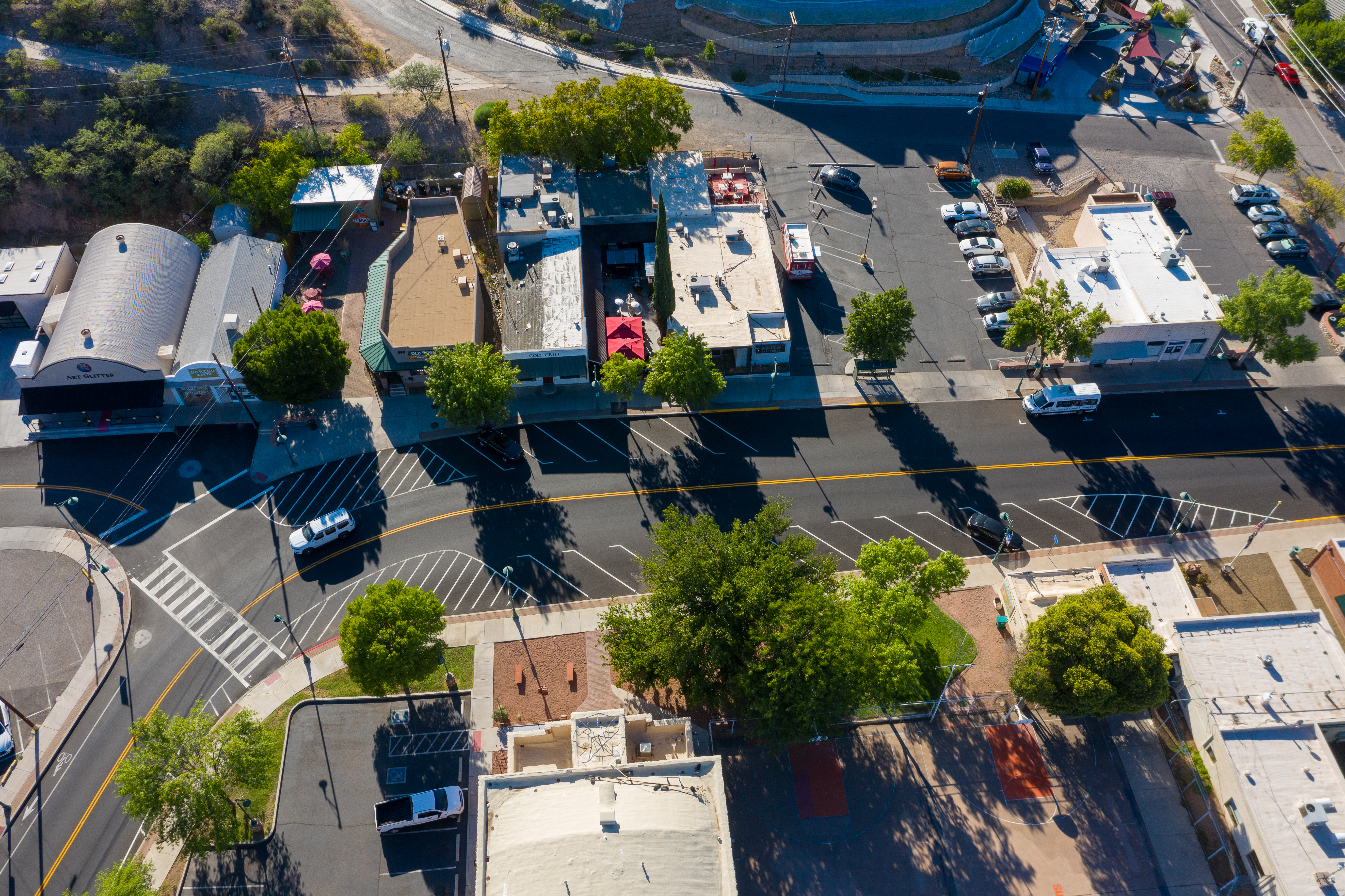
Earlier this year, Cottonwood city staff hired Kimley-Horn to conduct a parking study of the Old Town area to provide an inventory of parking and identify parking issues and parking management options. City Council had previously approved $70,000 for the parking study in the FY 24/25 budget.
Council received a presentation on the Old Town parking plan at its regular meeting on Tuesday, Sept. 16.
Senior Parking Consultant and Project Manager Jeremiah Simpson presented the study’s findings. The study area contains 682 parking spaces, 38% of which are on-street and 62% are off-street. Kimley-Horn included side streets in surveys, which aren’t specifically managed for public parking, but the city does not have signage saying drivers cannot park there.
The study looked at weekday parking utilization during peak season. On a Wednesday evening in late
March, the study found that people used about 67% of the available parking supply. Simpson said staff prefers to see parking systems at no more than 80% to 85% filled, otherwise there will be an excess in traffic circulation around the area. At the effective supply rate of 85%, 580 of Old Town’s 682 parking spaces would be used. On Saturdays, they found the peak utilization was at around 77% of the available supply.
Simpson said the Old Town Activity Park serves as an outlet valve, with many people circling North Main Street and coming across the gravel lot there.
An open house was held in May and an online public survey was put out and received around 250 responses. The preferred improvement strategies of those surveyed included adding more public parking options, designating more handicap-accessible spaces, creating metered or time-limited parking zones in high-usage areas, improving signage to guide drivers to available parking and providing designated parking for employees.
Of those surveyed, 64% of respondents came to Old Town for leisure with 84% driving alone at least some of the time. The majority of respondents, 69%, drove an SUV or truck, with 39% driving a sedan. Simpson said with a local population more SUV and truck-oriented, this statistic should inform a more comfortable design standard for planning future spaces.
In terms of future parking demands, the visitor growth rate is estimated to increase by 13.43% in 10 years, according to the Arizona Office of Economic Opportunity Population Projections. The employee growth rate is estimated to increase by 4.75% in the next decade, according to the Cottonwood City Atlas. Simpson said if those growth factors are realized, that would absorb all of the existing parking in Old Town.
Simpson recommended the city look at opportunities to expand the parking supply with an actual projected need at 80 spaces. If a residential parking program was put in place, he would recommend adding 150 spaces.
He said something they often see in downtowns not managing parking is that all-day parkers tend to occupy the most convenient parking stalls. One suggested strategy is to implement and enforce time-limited parking, which could be a precursor for paid meters. While this is good for businesses and encourages turnover parking, it would require a staffed position to enforce it. This could potentially be implemented during peak seasons only.
Another strategy is establishing funding mechanisms such as parking fines and paid parking. Simpson said this works better if tied to a specific need, such as expanding parking opportunities or reinvesting revenue into improved signage and streetscape, rather than simply collecting revenue from visitors.
Other possible strategies include unifying and expanding the signage system, pursuing shared parking agreements with local businesses, and exploring the idea of a circulator bus for larger events that connects Old Town to Riverfront Park. To enhance livability for locals, a resident parking permit program could be implemented, but this would decrease the available parking supply.
Councilwoman Debbie Wilden asked how many spots would be open if city employees moved out of Old Town. Financial Services Director Kirsten Lennon estimated it would be around 20 spaces.
Wilden asked about the costs for a garage, to which Simpson said parking is fairly expensive and does not generally pay for itself. A garage would need to generate about $250 per space per month to support both operations and debt costs. A charge for garage permits and a meter program downtown could help offset operating expenses, it’s most likely that debt for construction would need to be funded by other mechanisms.
Councilman Chris Dowell said people might spend less at businesses if they have to pay for parking. Simpson said, in his experience, most people are willing to spend the few dollars to park in a destination downtown or for a night out, but could consider managed two-hour parking as a first step to contribute to turnover for traffic into local businesses.
Cottonwood Community Development Director Scott Ellis said this will supplement the Old Town Master Plan which will be brought back to council at a later date.