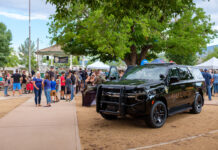

The Camp Verde Marshal’s Office is expanding the use of automated license plate recognition technology, by having secured a grant for four Motorola Mobile ALPR cameras. These will be mounted on patrol vehicles using funds from the Arizona Opioid Settlement Grant.
CVMO is joining the cities of Cottonwood and Sedona, which have installed stationary cameras manufactured by Flock Safety, a rival company that maintains a separate nationwide surveillance network.
Additionally, CVMO has applied for four stationary Flock cameras to create a surveillance program through the U.S. Department of Justice’s Edward Byrne Memorial Justice Assistance Grant program. However, there is no timeline for when a decision on that grant will be announced.
Security v. Surveillance
ALPR cameras document every vehicle that passes by, capturing the make, model, license plate number and other features. The data is uploaded to cloud servers and used to generate searchable profiles.
“Because license plate readers do not collect information on who is driving or riding in the vehicle, it is not considered Personally Identifiable Information,” Flock Safety promotional material reads.
However, critics argue that the data collected by ALPRs may seem innocuous, such as noting fender damage, the systems also capture details like bumper stickers, potentially revealing and recording an individual’s political beliefs. Furthermore, the detailed records ALPRs create can lead to mass surveillance of entire communities, including people not suspected of any crime, since the cameras scan every vehicle and convert the images of license plates into searchable text.
“Flock is the first to create a nationwide mass surveillance system out of its customers’ cameras,” American Civil Liberties Union senior counsel Chad Marlow stated in 2023. “Unlike a targeted ALPR camera system that is designed to take pictures of license plates, check the plates against local hot lists and then flush the data if there’s no hit, Flock is building a giant camera network that records people’s comings and goings across the nation, and then makes that data available for search by any of its law enforcement customers. Such a system provides even small-town sheriffs access to a sweeping and powerful mass surveillance tool, and allows big actors like federal agencies and large urban police departments to access the comings and goings of vehicles in even the smallest of towns. And every new customer that buys and installs the company’s cameras extends Flock’s network, contributing to the creation of a centralized mass surveillance system of Orwellian scope.”
The Electronic Frontier Foundation, a nonprofit, warns that because of the massive amount of sensitive data collected by documenting every vehicle on a road that “few agencies are equipped, staffed, or trained to harden their systems against quickly evolving cybersecurity threats.”
Camp Verde Use
Among the cited reasons for ALPR in Camp Verde are “to enhance public safety, track stolen vehicles and assist in drug trafficking investigations,” CVMO Patrol Cmdr. Dan Jacobs said.
The Motorola Mobile ALPR “cameras will be mounted in select patrol vehicles and will have the same capabilities as the stationary [Flock] cameras,” Jacobs wrote in a recent email. Jacobs said that he does not have an estimated date when those will be in service since the purchase order has not been made yet.
If awarded, the four stationary Flock cameras would be placed on yet-to-be-determined “thoroughfares coming into Camp Verde,” according to Jacobs.
Jacobs said that CVMO’s need for this ALPR technology is to “help the department and the officers, whether it’s tracking a stolen vehicle, a missing person, or some kind of a public need for identifying someone.”
However, CVMO did not cite a specific criminal incident or trend of criminal activity that necessitates the deployment of ALPR technology in Camp Verde, and that the decision was influenced in part by trends in neighboring jurisdictions rather than specific Camp Verde incidents.
“No, it just kind of seems to be the wave of the future as far as surrounding agencies are going to [use] that kind of [equipment],” Jacobs said. “So it’s just we need to jump on board and kind of use the resources that are out there.”
Town Manager Miranda Fisher wrote in a recent email that part of the intent is “to connect to other jurisdictions systems/data.”
Jacobs said the cameras will aid in locating stolen vehicles, wanted persons, and responding to Amber or Silver Alerts, as the system integrates with other law enforcement databases.
Camp Verde currently has no data-sharing agreements in place with other agencies. Such agreements would come likely after installation, at which point CVMO could with Town Council approval opt in to share and receive information with other participating agencies.
“Like the Flock system, the Motorola cameras will allow CVMO to access the Motorola ALPR database and integrate with other agencies who use this system,” Jacobs wrote.
Jacobs said the department has a policy in place regarding the data collected. An administrator will be assigned to oversee it and will be responsible for conducting regular audits to ensure the department’s rules are being followed and to detect any unauthorized access or searches. Additionally, most agencies keep the data for 30 days before it is purged from the system.
Funding from Opioid Settlement
The One Arizona Agreement dictates the terms of how $1.12 billion in settlement funds can be used. Funds come from the nationwide grocery chain Kroger — which agreed to pay to settle claims regarding its role as a distributing pharmacy — separating it from other litigation against pharmaceutical companies, distributors and marketers related to the opioid crisis.
Approved uses include supporting “current and future law enforcement expenditures relating to the opioid epidemic and educate law enforcement or other first-responders regarding appropriate practices and precautions when dealing with fentanyl or other drugs.”
The Town Council unanimously approved joining the national opioid settlement agreement on July 17, 2024, during which Fisher said the funds would be used for drug enforcement or education.
“So the portion for that would be the helping of tracking trafficking and locating, like, somebody who is a known drug trafficker,” Jacobs explained in how the funds relate to agreement. “So if their plate was entered in the system by another agency saying ‘be look out this vehicle is transporting drugs,’ then it would pop up like when it would pass our camera system.”
However, to do that, ALPRs scan every vehicle on the road that passes by.