
Author Ken Mochizuki discussed his book “Michi Challenges History: From Farm Girl to Costume Designer to Relentless Seeker of the Truth: The Life of Michi Nishiura Weglyn” as part of the Arizona Research Library’s 2024 Arizona Author Series on Feb. 15.
Mochizuki was born and raised in Seattle, Wa., and is the author of the award-winning and best-selling picture books “Baseball Saved Us,” “Heroes” and “Passage to Freedom: The Sugihara Story.” He also covered the Japanese-American World War II experience and Asian-American history as a journalist.
Mochizuki’s young adult nonfiction book on Michi Nishiura Weglyn follows Nishiura from her internment at the Arizona Gila River concentration camp to becoming a costume designer on Broadway and later researching and uncovering the truth about American internment camps.
Mochizuki said that the more he researched Nishiura’s life story, the more he found out how astounding she was.
The Issei were the first generation of Japanese in the U.S. and could not become citizens until 1952. The Nisei, or children of the Issei, were born in the U.S. and were citizens from birth. The Kibei were Nisei who were sent to Japan to be educated before returning to America. Sansei are the grandchildren of the Issei, Mochizuki among them.
Mochizuki said that many young Japanese men emigrated to America in the late 19th and early 20th centuries, as agriculture was being phased out in Japan in favor of industrialization at the time. The Japanese also continued to carry on the tradition of male primogeniture, often pushing younger sons to emigrate.
Nishiura was born in 1926 and grew up on a farm in Brentwood, Calif., where her family were sharecroppers. Mochizuki said that Nishiura loved animals and that when she saw chickens born without feathers, she set out to design small furry sweaters for them, hinting at her future career. On one occasion, when her mother took her to see a show, she picked a performance based on which costumes looked the most extravagant on the posters and they ended up at a burlesque show.
After the attack on Pearl Harbor on Dec. 7, 1941, the FBI began rounding up Japanese immigrant community leaders. By April, Nishiura’s settlement received notices that they had to leave and could only take what they could carry. All persons of Japanese descent were forcibly removed from the coasts of Washington and Oregon, all of California and a part of Arizona.
Nishiura’s family was taken to the Turlock assembly center operated by the U.S. Army, where they were surrounded with barbed wire with machine guns pointed at them. After a few months, the family was transferred to a permanent camp, the Gila River War Relocation Center, which held up to 13,000 people. Nishiura’s family of four lived in a 16-by-20-foot room with another family of four.
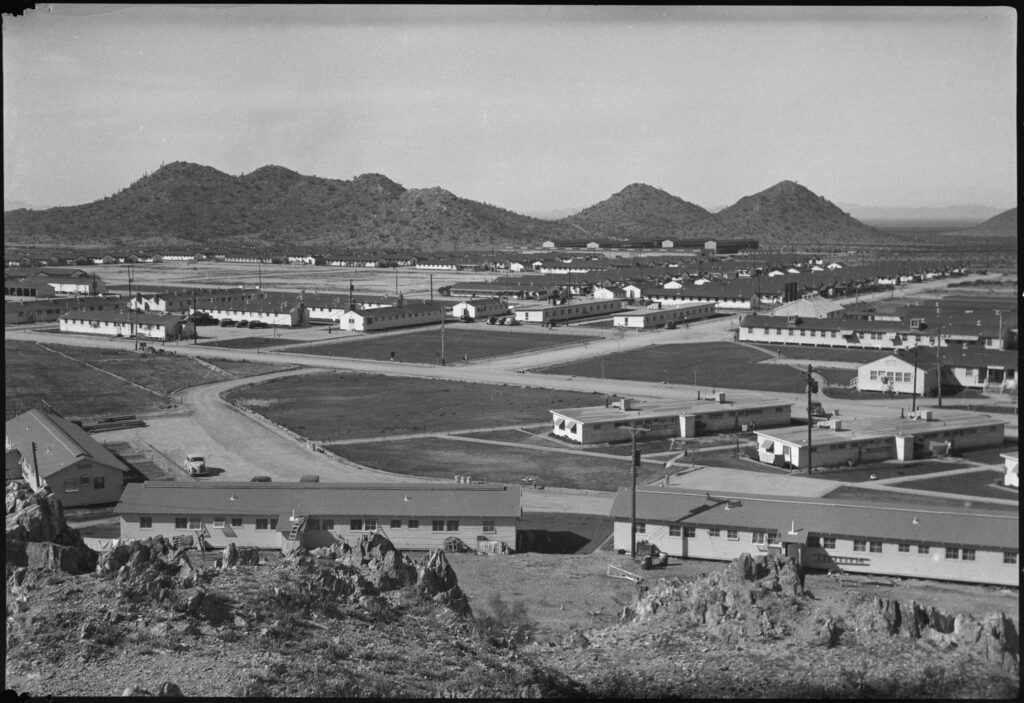
Photo courtesy of the National Archives
Mochizuki said that Nishiura began to blossom at the camp, where she formed and became president of a Girl Scout troop and later threw a Girls’ League convention at the camp with high school girls from across the Phoenix area.
By 1943, those at the camp were able to leave to attend school or work. Nishiura received a full scholarship to Mount Holyoke College, where she studied biology and won a campus wide contest to design a costume for the school’s production of “A Midsummer Night’s Dream.” In 1945, she contracted tuberculosis and had to drop out of school. Nishiura later joined her family in Seabrook Farms, N.J., where they worked at a factory.
Aiming at a job in the theater industry, Nishiura moved on to Barnard College and the Fashion Academy of New York. She soon met her future husband, Walter Weglyn, a German Jew who had escaped from a Nazi concentration camp and worked as a perfume chemist.
She worked on a television show in 1954 and was later hired by “The Perry Como Show,” where she worked for a decade. Mochizuki said that she knew how to use clothes to make the wearer look better.
Weglyn was unable to find a job as a costume designer until 1962, when she was asked to design costumes for “Ice Colorama,” a Broadway production at the Roxy Theatre.
By the 1960s, Weglyn began researching internment camps and later published, “Years of Infamy: The Untold Story of America’s Concentration Camps,” in 1976 after eight years of research and writing.
Mochizuki said Weglyn’s book gave a major boost to the redress movement, an 18-year effort led by JapaneseAmericans to get the American government to acknowledge the unconstitutionality of internal camps based on race or national origin. This culminated in President Ronald Reagan signing the Civil Liberties Act of 1988, which included a formal apology to Japanese-Americans for their wartime internment.
In 2018, the U.S. Supreme Court formally overturned the 6-3 ruling in the 1944 case Korematsu v. United States that allowed internment camps. “Korematsu was gravely wrong the day it was decided, has been overruled in the court of history, and to be clear ‘has no place in law under the Constitution,’” the opinion stated.
For her work, Weglyn received many honorary degrees, including from Mount Holyoke, where she had been unable to finish school due to illness. Weglyn died in April 1999.
Mochizuki’s book can be purchased at this link.