
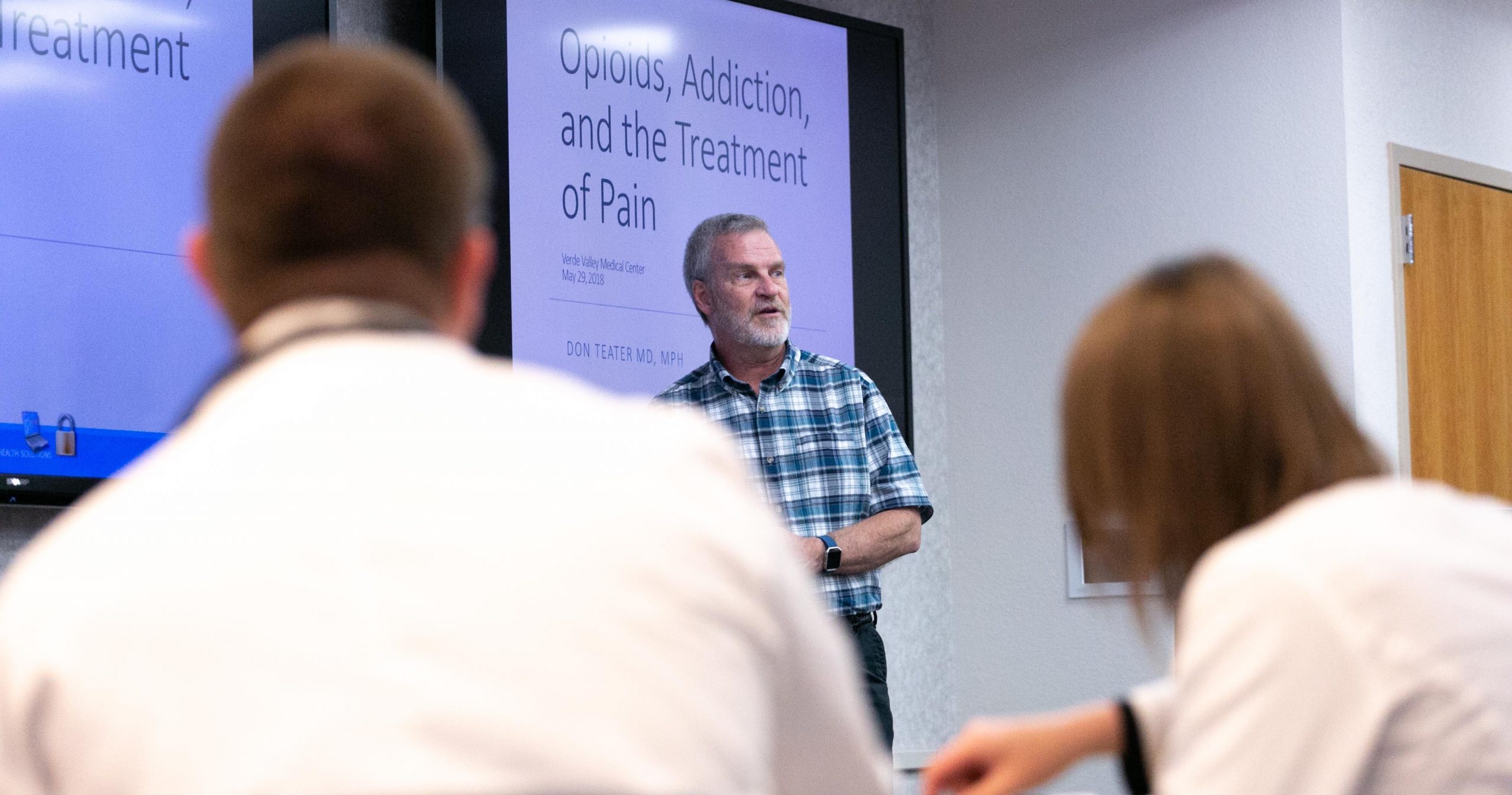
“Despite the fact that we’re prescribing so many opioids, we have more people in pain,” said Dr. Don Teater, from Waynesville, N.C. “Opioids are not fixing the problem. In fact it’s getting worse.”
Teater spoke to a room of doctors and other medical professionals at Verde Valley Medical Center on Tuesday, May 29, as an expert of many years in two related fields of medicine — pain treatment and drug abuse.
Teater told the doctors things they had learned in medical school, methods the entire medical profession treated as correct, practices that they engaged in on a near-daily basis, were wrong.
Teater explained how long-term chronic pain works, about how it was different than the short-term acute pain from an injury, or surgery or an infection. The latest research on chronic pain suggested it could be affected as much by the patient’s environment, psychological state and other factors, such as injuries or damage to nerves.
He referred to “central sensitization” pain that originates in the brain and travels to the nerves, as opposed to vice versa. He tied that in to how opioids, a default prescription for long-term pain, were frequently unable to solve chronic pain, and could make the pain worse.
There have been dire consequences to misunderstandings in the medical profession about the use of opioids to treat chronic pain, he said.
According to the Centers for Disease Control and Prevention, 116 people in America die daily from opioid-related drug overdoses. More than 42,200 people died from opioids in 2016 alone.
2016 marked the first year since the 1960s when American life expectancy declined, from 78.7 years to 78.6. Experts attribute that fall to the opioid crisis.
“As I talked to my patients who were addicted, I began to hear their stories about how they got addicted, and I realized that at least half of them got addicted from me and my colleagues prescribing too many opioids for too long,” Teater said.
Many patients who get hooked on opioids via a prescription end up moving towards rawer illegal forms of the drugs, like heroin and fentanyl.
“It’s a significant problem,” said Marilee Fowler, the executive director of MATForce, a anti-drug group in Yavapai County.
According to Fowler’s data, there were 18 opioid overdose deaths in 2016 in Yavapai County, a worsening trend after an improvement a few years ago, but better than the 30 deaths in 2011 at the epidemic’s peak in the area.
“There definitely are people of all ages that are dying, whether it’s from heroin or prescription drug overdoses,” Fowler said. “The thing that we’ve learned from looking at the overdose deaths is that it really isn’t just an opioid problem or epidemic. It’s a drug epidemic. Because what’s happening is it might start with opioid addiction, but there’s a lot of people that are using heroin that are also using meth[amphetamine] and multiple drugs. When we look at the overdose deaths it’s very common that they have multiple drugs in their system.”
Teater explained ways opioid prescriptions fail to handle chronic pain and cause more problems.
He focused on how opioid abuse could end up exacerbating a user’s pain problem through environmental factors.
He highlighted additional chronic pain caused by opioid withdrawal, that could, in some cases, leave a patient in more pain than before the medication.
He also discussed what he called the “Dorothy reaction,” named for “The Wizard of Oz” character’s response to poppies: When a patient tries opioids for the first time and gains a newfound confidence off the high, it can lead to addiction quickly and heavily.
Pain and opioids can have especially dire effects on elderly patients, Teater said. Not only are the elderly common victims of chronic pain, but opioids can have even more dangerous side-effects.
“After we get past 50 — I notice it now — our brains just don’t work quite as good,” Teater said. “Any medicine that impairs your brain is going to magnify that a little bit, and opioids are one of those.”
“They are impairing mentally in the elderly. They’ve been shown to increase the risk of fall and fracture by a factor of four.”
Teater came with good news as well.
Opioids were not the most effective way to treat pain. According to a study by Cochrane, an international medical research nonprofit, 21 percent of patients prescribed opioids saw pain reduction by 50 percent. In comparison, of patients treated with a combination of ibuprofen and acetaminophen, two over-the-counter medications with far more limited side effects, 62 percent saw a 50 percent reduction in self-reported pain levels.
“Basically, there’s no evidence that opioids work for chronic pain,” Teater said.
He recommended a combination of behavioral and physical therapy and lifestyle changes to treat patients with long-term pervasive pain. He recommended a strategy by which, even if the pain could not be lessened, an improved quality of life could dampen the impact of the pain and the portion of a patient’s mind that dealing with the pain takes up.
Teater also brought encouraging news about efforts to treat those addicted to opioids.
While many abstinence-based attempts at getting a patient off opioids can lead to quick and demoralizing failure — Teater argued that quitting cold-turkey could actually make things worse than just continuing with the addiction — medication-assisted treatment, moving a patient on to alternative drugs like methadone or Suboxone that satisfy an addict’s cravings but lack the dangerous side effects, have high success rates.
“It’s the hardest to treat without medication but the easiest to treat with medication,” Teater said.
Teater also praised Naloxone, an emergency medication that reverses overdoses and can prevent death. He argued that Naloxone should be at least as common as EpiPens.
The goal, however, is and head off the opioid crisis well before reaching the point of saving someone from an overdose.
“I think that we are in a markedly evolving sphere of thinking,” said Dr. Richard Neff, chief medical officer of Northern Arizona Healthcare, which owns VVMC.
Neff expressed hope that the hospital system was learning how to handle things better, despite the few number of chronic pain specialists in Northern Arizona.
“We’re trying not to have patients on super-high doses of opioids for a very long time,” Neff said. “We’re rethinking a lot of things about chronic pain.”
“I know we’ve saved lives,” he said.
Jon Hecht can be reached at 634-8551, or email jhecht@larsonnewspapers.com