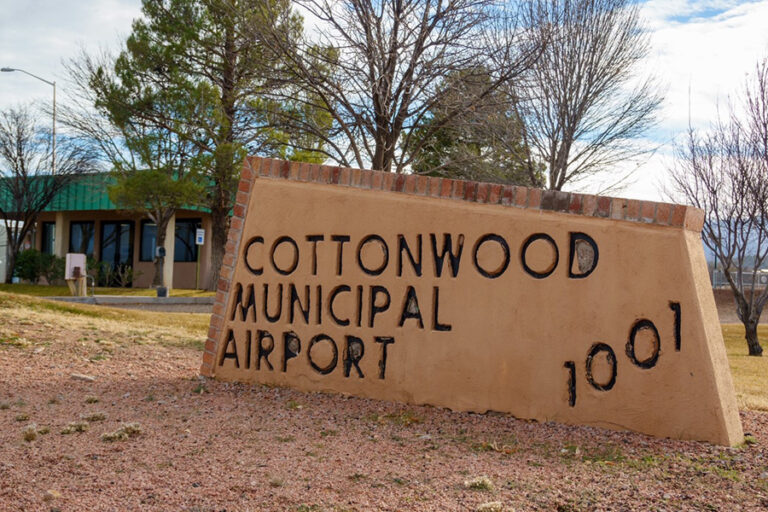
Pilots flying in and out of Cottonwood Municipal Airport can now review updated guides for both fixed-wing aircraft and helicopters. The guides include recommended noise abatement practices and standard operating procedures to help promote safe, courteous and consistent flight operations.
Airport officials encourage all pilots to take a few minutes to review the updated information before flying.
The updated guidelines outline noise abatement practices and standard procedures for both aircraft types:
Fixed-Wing Aircraft
- Arrivals: Maintain traffic pattern altitude until necessary for landing; avoid low-altitude, high-RPM approaches on extended downwind, base and final; and follow the precision approach path indicator to indicate a safe glidepath and allow a smooth, quiet descent to the runway.
- Departures: Avoid flying over residential areas with the propeller set to low pitch and high RPM.
- General: Runway 32 is the preferred runway for noise abatement; avoid touch-and-go flight training operations between 6 p.m. and 8 a.m. weekdays and 6 p.m. and 9 a.m. weekends and holidays; conduct full-stop taxi backs before 8 a.m. weekdays and before 9 a.m. weekends and holidays; limit touch-and-go flight training operations in the traffic pattern to no more than three aircraft at any time; stop-and-go, midfield and intersection departures are prohibited; piston aircraft operators are requested to use Aircraft Owners and Pilots Association “Noise Awareness Steps”; and turbine and jet aircraft operators are requested to use National Business Aviation Association “Noise Abatement Program” procedures or comparable manufacturer procedures.
Helicopters
- Arrivals: When 10 miles from the airport, provide position, altitude and arrival intentions on CTAF 122.700; approach entering midfield for Runway 14 or 32 headings depending on wind and traffic; maintain appropriate altitude until assured landing; and use caution to avoid parked fixed-wing aircraft when landing and parking.
- Departures: Provide departure intentions on CTAF 122.700; depart northeast on Runway 32 heading or southeast on Runway 14 heading [depending on wind and traffic] using best rate of climb until reaching 500 feet above ground level; and remain aware of fixed-wing aircraft departures on Runway 32.
- General: Be advised of student training fixed-wing aircraft using the right traffic pattern for Runway 32 at 800 feet AGL; avoid flight training operations between 6 p.m. and 8 a.m. weekdays and 6 p.m. and 9 a.m. weekends and holidays; avoid flying over residential areas to the extent possible; and avoid directly flying over the town of Clarkdale north of the airport and the town of Jerome west of the airport.
Standard Procedures
Runway 32 is designated a calm-wind runway; use extreme caution to avoid the potential approach and landing of skydivers, hang gliders, paragliders and ultralights; use caution for medical and aerial tour helicopters operating to and from the airport and hospital heliport; use caution for heavy flight training activity; and maintain operation “Lights On” at all times.
Traffic Pattern Direction: Runway 14 uses a left-hand rectangular pattern; Runway 32 uses a right-hand rectangular pattern.
Traffic Pattern Altitude: Helicopters fly at 4,060 feet mean sea level, 500 feet above ground level; single-engine aircraft at 4,360 feet MSL, 800 feet AGL; multi-engine aircraft at 4,560 feet MSL, 1,000 feet AGL; and turbine aircraft at 5,060 feet MSL, 1,500 feet AGL.
For more information, visit cottonwoodaz.gov/369/Airport.