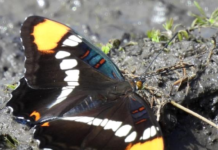
Butterfly Enthusiasts of Northern Arizona host mothing event, find nocturnal insects and spiders
Members of the Butterfly Enthusiasts of Northern Arizona flock to insects like moths to lamps.
That’s why after sunset on July 22, the club set up two black lights hanging against a white sheet at Riverfront Park in Cottonwood.
Since moths are in the same taxonomic order as butterflies — Lepidoptera, meaning “scale-wing,” according to the U.S. National Park Service — Janie Agyagos wanted to do something special for National Moth Week, which was Saturday through Sunday, July 18 through 26.
“I texted Becky [Hardy, one of the founders of BENA] and I said ‘I know a moth expert,’” Agyagos said during the mothing field trip on July 22. “‘Let’s do moth appreciation.’”
Agyagos is a retired U.S. Forest Service wildlife biologist who spent 31 years working in the Red Rock Ranger District I of three districts in the Coconino National Forest.
She said spending time in the Prescott National Forest, for events like these, is also fun.
While waiting for it to get dark and moths to come to the black lights, she took the about 10 people who wanted to walk around on a short field trip, looking for eye shine.
“A lot of animals have a tapetum lucidum in their eye,” Agyagos said. “It’s a reflective lens that allows them to see better, gather more light at night. … A lot of things have it. Even fish have tapetum lucidum. Frogs and toads have them. All the insects have them. You can see eye shine on moths that might be on trees.”
While walking along the riverbank, she gestured to some bushes.
“Oh, I’m seeing all kinds of spiders just right in here,” she said. “I’m going to turn my light off. Everybody, one at a time, look at all the blue glittery eyes in there.”
There were too many to count.
Spiders and Beetles and Moths, Oh My!
Hence the name, the Butterfly Enthusiasts of Northern Arizona generally focus on butterflies.
It’s the local chapter of the North American Butterfly Association, which Hardy and Denise Gibbs formed just last year.
“We started meeting in February and then every other month during butterfly season, so February, April, June, August and then October is our last chapter meeting,” Hardy said.
The July mothing occasion, though, worked well with its usual type of programming, like different talks, demonstrations and field trips throughout the year.
Following the walk along the riverbank, the group returned to the white sheet hanging between trees with the black lights.
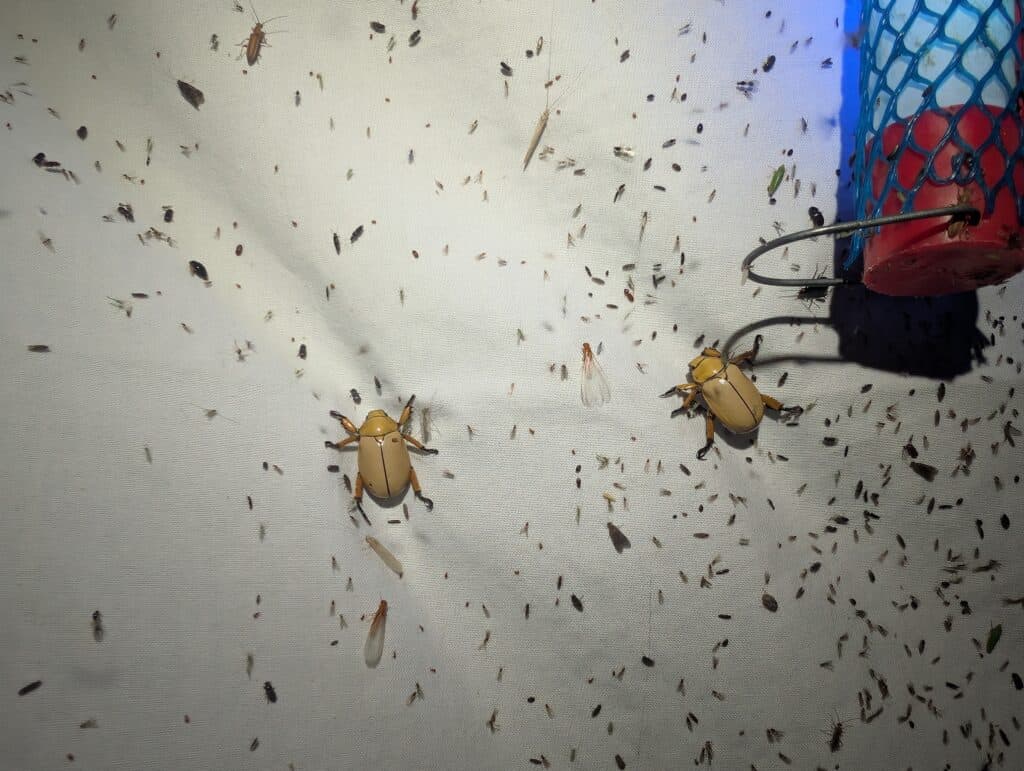
Hundreds of tiny insects had swarmed around the lights, with dozens of larger beetles and several moths.
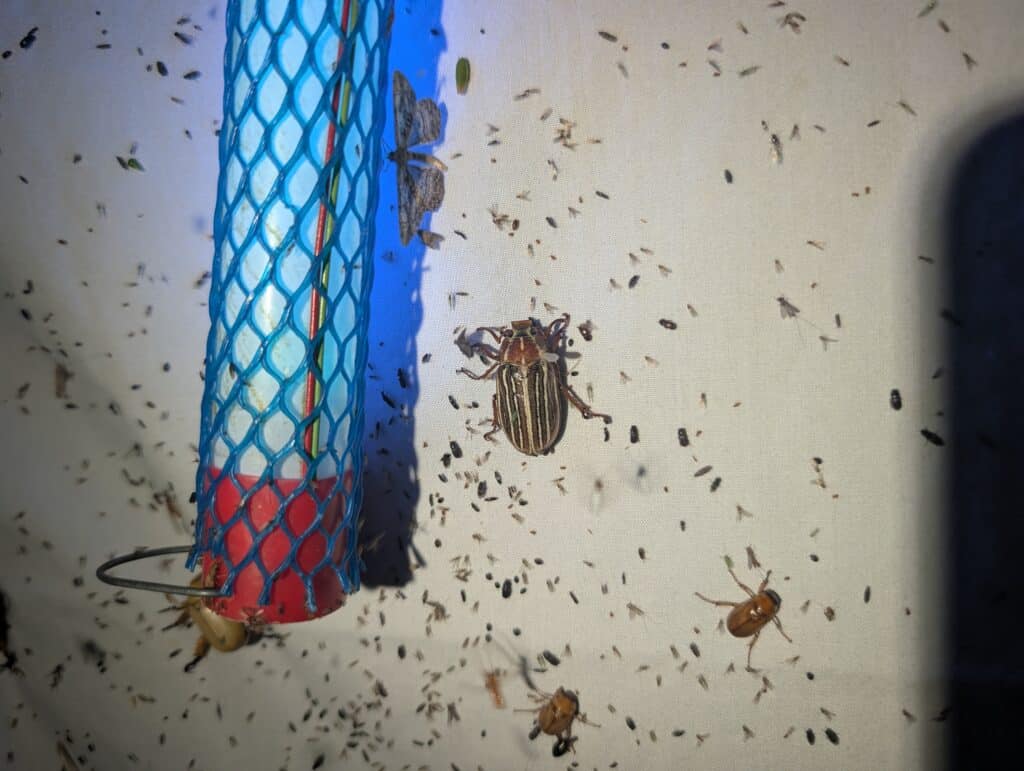
“There’s a gold smith beetle,” she said, pointing to one hanging on the sheet below the light. One of the attendees asked about one hanging on the other side of the black light. “That’s a June bug.”
She picked up a long, thin, dark-colored beetle that she called a click beetle. She dropped it so it landed upside down.
“If you flip them upside down, they’ll click,” she said.
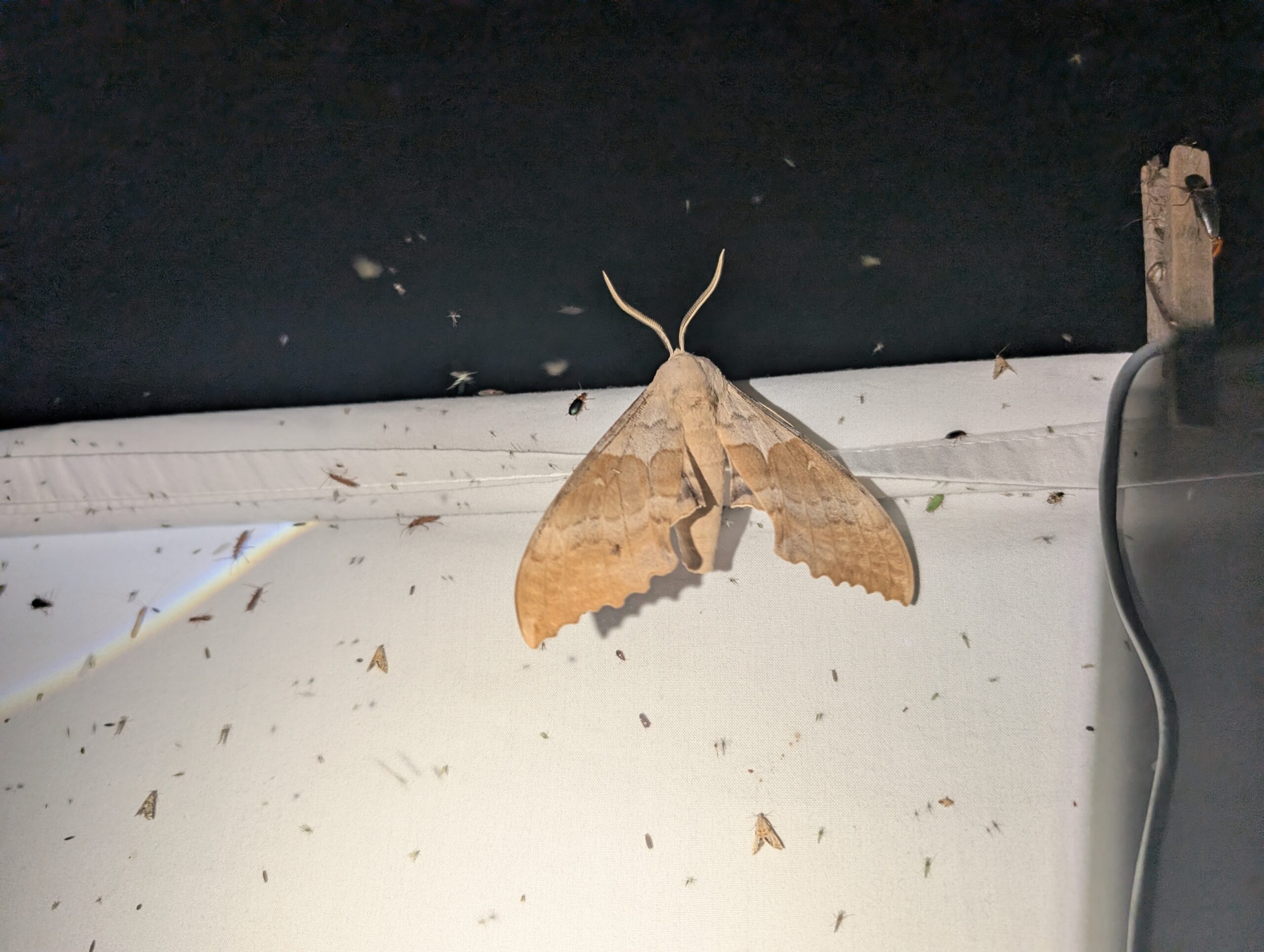
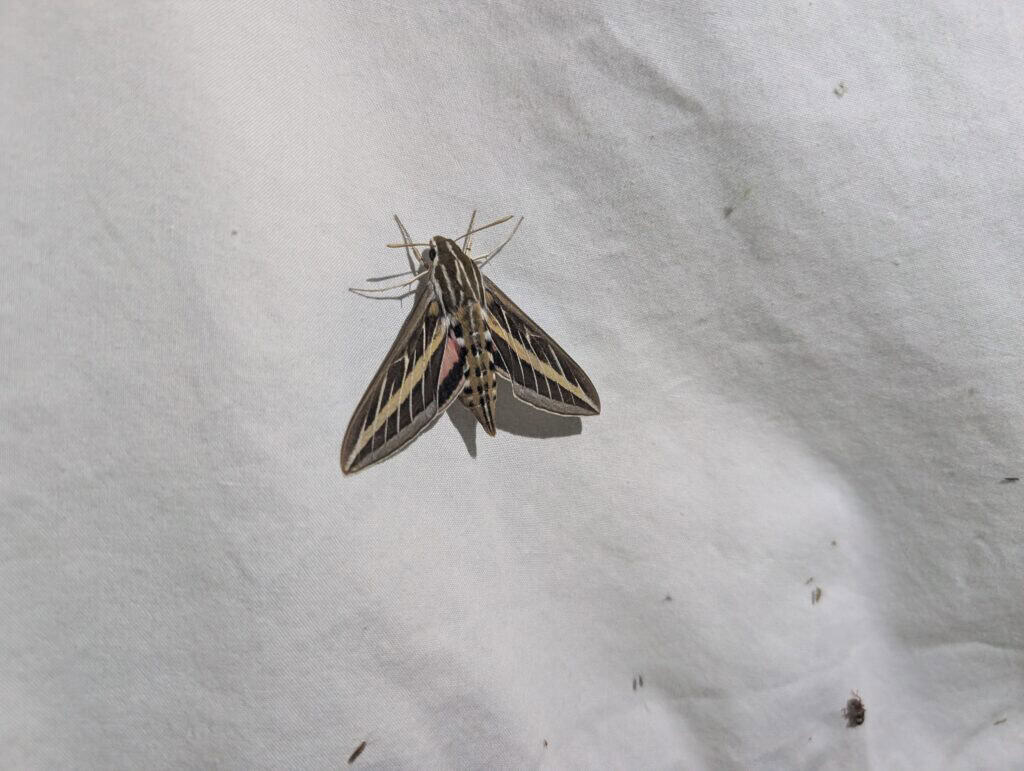
The moths that swarmed the lights varied from slightly smaller than a dime to about hand sized.
Mostly, they were different types of Sphinx moths, the most recognizable being the White-lined Sphinx Moth.
Agyagos will teach a six-week course on local animals at Yavapai College’s Sedona Center through Osher Lifelong Learner Institute. The class is limited to 20 people and goes from 10 to noon on Wednesdays starting in September.
There’s no Place like BENA
Hardy said she’s been interested in butterflies since she was little.
“I can remember being in my front yard and seeing butterflies and trying to capture them,” Hardy said. “It just became an obsession as I got older, learning about them, IDing them and all that stuff.”
Her friend, Gibbs, used to work on monarch butterfly conservation in Maryland.
She’s been organizing her own butterfly count in the Cottonwood area every August since 2016. Now that she and Hardy founded the club, they can have more volunteers and have counts in Sedona as well, which happened in May.
In addition to its educational talks and field trips, it also hosts demonstrations, like monarch butterfly tagging, which recently proved that monarchs in U.S. migration patterns have ended up in Mexico in past years.
A recent development for BENA is the addition of local radio tags for butterflies.
Traditionally, butterfly tagging is done with a sticker, but advancements in technology similar to Motus radio tags for birds have allowed butterfly enthusiasts to have similar tracking capabilities to local Audubon societies.
“We were able to raise funds, they’re called blue receivers, … to install two receivers on their [Northern Arizona Audubon Society] Motus stations,” Hardy said. “One of our stations is technically south of Flagstaff in Anderson Mesa … and then we also have another on the Verde [River] in Camp Verde that is on a private ranch.”
It can tell the club more about what butterflies come through, where they came from and how long they stay.
“If a butterfly is radio tagged and flies within one-and-a-quarter miles of this receiver, it can pick them up,” Hardy said.
Anyone interested in joining can do so at butterflyenthusiastsofnaz.org.
Membership is $35 for the year and benefits include a twice-quarterly “American Butterflies” magazine and a quarterly newsletter. Membership is not required to participate in BENA sponsored events, and all are free and open to the public.
Upcoming BENA events include the Butterfly Big Sit: Monarch Waystation Pollinator Garden, which involves observing butterflies in Page Springs; the Cottonwood area butterfly count, which anyone can volunteer for, on Friday, Aug. 28; and the inaugural Butterfly Festival on Saturday, Sept. 12, 9 a.m. to noon at the Sedona Wetlands Preserve.