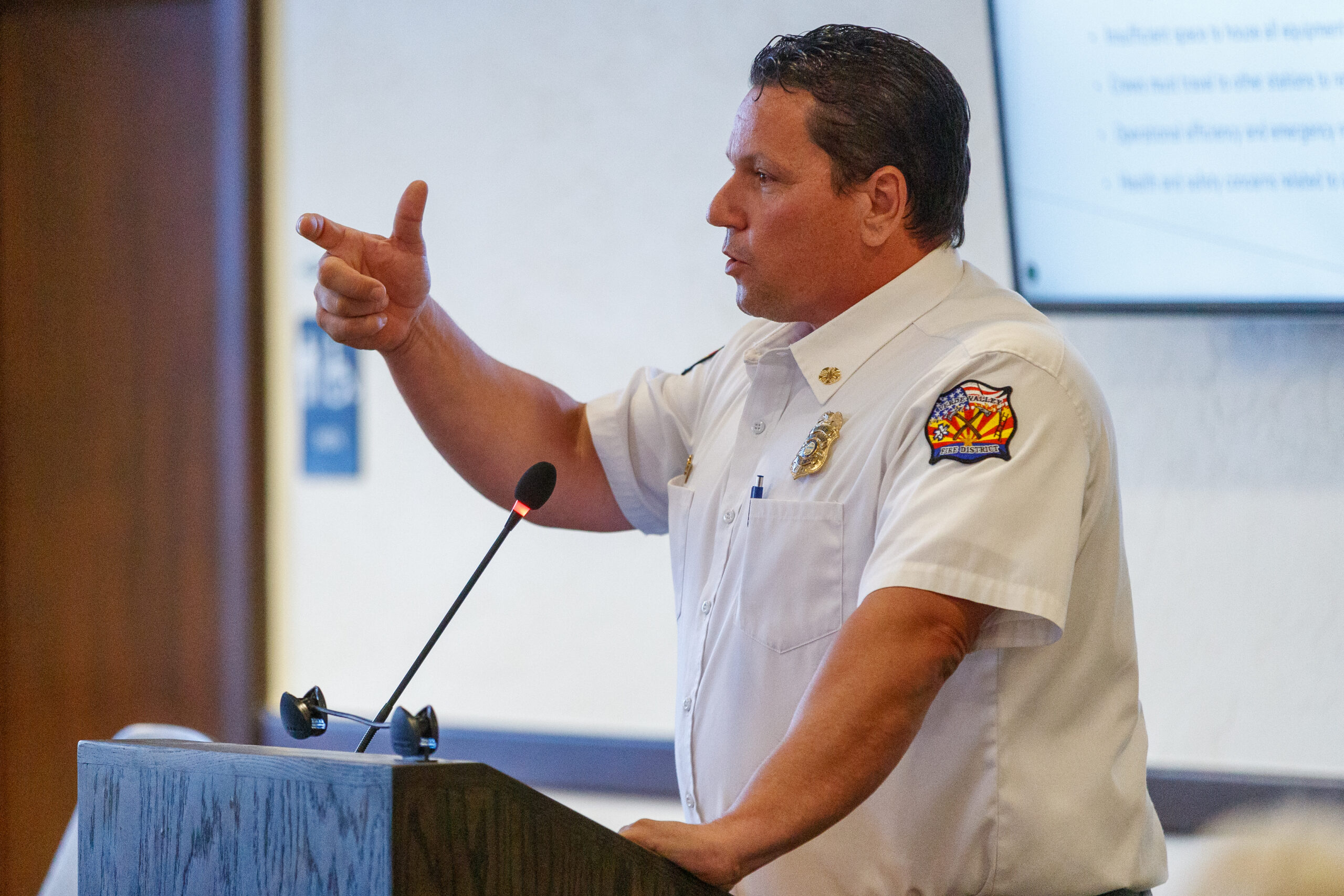
Verde Valley Fire District Fire Chief Danny Johnson gave a presentation to the Clarkdale Town Council on VVFD’s general obligation bond at the council’s regular meeting on Tuesday, Aug. 26.
A GO bond is a loan taken by the fire district restricted to capital purchases and improvements. VVFD’s governing board has called for a bond election this November to seek additional funding to meet all of the district’s capital and operational needs.
Johnson listed the reasons why the board feels the district is in need of a bond, including a call volume increase of more than 58% over the past decade. Rising costs of emergency equipment and construction has significantly increased, while their vehicles and equipment are nearing the end of their useful life cycles.
tionary costs affect worker’s compensation insurance, which has risen by 241%, limiting the district’s choices. The cost of new fire engines has increased by 128%. An engine the district purchased 10 years ago cost $440,000, while the one that was recently approved for purchase costs just over $1 million. Fire station construction costs have gone up by 161%. Johnson stressed the district’s current budget resources are insufficient to address these challenges.
Johnson said the bond will cover five main issues: Address emergency communications infrastructure, construct a new fire station in Clarkdale, renovate current stations, secure district assets and increase their level of response.
After being approved by voters and the Yavapai County Board of Supervisors, the Clarkdale Fire District and its station consolidated in Verde Valley Fire District on July 1, 2016, under VVFD Fire Chief Nazih Hazime, with then-Clarkdale Fire Chief Joe Moore becoming Hazime’s assistant chief and later VVFD’s interim chief when Hazime retired in August 2018.
Johnson said updating the district’s emergency communications infrastructure affects the entire Verde Valley, not just Clarkdale.
VVFD currently has two working repeater sites covering the whole district. These are over 10 years old and their reliability is often affected by weather events. He showed council a map with large swaths of land that have limited to no reception in the district. VVFD need to replace the repeaters nearing the end of their lifespan and build a communications ring with point-to-point connections, Johnson said. This way, if there’s a break in infrastructure, communications can continue to operate with no pause in service.
The current Clarkdale fire station is owned by the town with a lease that began in 2016 and ends in 2031. VVFD has currently outgrown the building, Johnson said, adding that while 2031 sounds far off, the process will take years — and the town also has grown and needs space.
Clarkdale had 2,282 residents in 1990, 3,436 in 2,000, 4,039 in 2010, 4,535 in 2020, and an estimated 4,951 in 2024.
Johnson said one of the main things VVFD is doing is trying make sure the public understands the construction of a new station impacts more than just Clarkdale. Crews sometimes have to travel to other stations to get equipment before responding to calls, delaying response times. If the crew in Clarkdale needed a wildland fire truck, VVFD’s main engine for wildfire response, crews would need to go to another station to retrieve it as the current station lacks the space. The current station also no longer meets industry safety standards and there are health and safety concerns over contaminants and carcinogens.
VVFD Stations 31 and 32 were built before certain environmental hazards were identified and need to be renovated. High-use areas like kitchens and bathrooms need to be updated, especially with non-porous surfaces to reduce environmental exposures. Contaminants from fire scenes can be brought back to the station and its living quarters, leading to long-term exposure. Johnson said bedbugs and scabies are some of the things firefighters encounter during calls.
Security also needs to be upgraded with new door and bay locks to ensure firefighters are safe and their equipment secure. Johnson said they’ve had crew members come back from calls to find transients using their showers and sleeping in their beds.
Both stations need exhaust removal systems in the bays to remove diesel exhaust, a known carcinogen. When the trucks are parked and running in the bay, the fumes get pushed into the firehouse’s main living quarters.
Station 31 also needs a septic system replacement. VVFD has had to shut the station down multiple times after being flooded with sewage.
Firefighters have a significantly higher chance of contracting cancer due to exposure to multiple carcinogens throughout their career. Johnson said these risks should not be a consequence of the career firefighters have chosen, and there are things they can do to help address and reduce these exposure risks.
“These statistics that we’re seeing coming out in the fire service are pretty staggering,” said Seth Murphy, who represented the Sedona Verde Valley Fire Fighters Association, the local union. “The life expectancy of firefighters after retiring is pretty minimal. Without action that we desperately need, it’s just going to get worse.”
Factors in the design and construction of a firehouse can mitigate post-traumatic stress disorder exposures by reducing psychological stressors. Separating working and living areas is another method to mitigate exposures, as well as having decontamination zones and proper storage of personal protective equipment.
The bond project is set to be in two phases. If approved, Phase One is projected to start in March 2026 with a $10 million bond sale to fund $2 million of infrastructure improvements, $7 million for the construction of Station 36 in Clarkdale and $1 million in contingency. Phase Two will take place in 2027-28 with a $5.5 million bond sale funding $3 million into health and safety improvements for Station 31, $2 million into health and safety improvements for Station 32 and $500,000 in contingency.
While the district can obtain loans or leases, the repayment of those projects then have to come out of operational costs. The bond is structured to be repaid in about 20 years, so the repayment would be spread out among current and future taxpayers of the region.
If the bond is not approved, the district will rely on operational funding. VVFD will then have to cut projects proposed with the bond, and with that cut, the remaining projects will take roughly 30 years to complete, due to the current financial situation.
The total bond issued will be $15.5 million. Johnson laid out the estimated cost to taxpayers. For example, a house with an assessed limited property value of $100,000 will have to pay $32 annually or $2.70 a month in taxes that the bond rate can be applied to. Residents can determine their property’s assessed value on Yavapai County’s website to estimate this additional cost.
“It’s really an important thing for Clarkdale,” Mayor Robyn Prud’homme-Bauer said. “We’ve waited a long time to get a new fire station here.” She added the biggest part will be convincing the public what it will mean to the Clarkdale and Verde Valley communities to have this new station.