
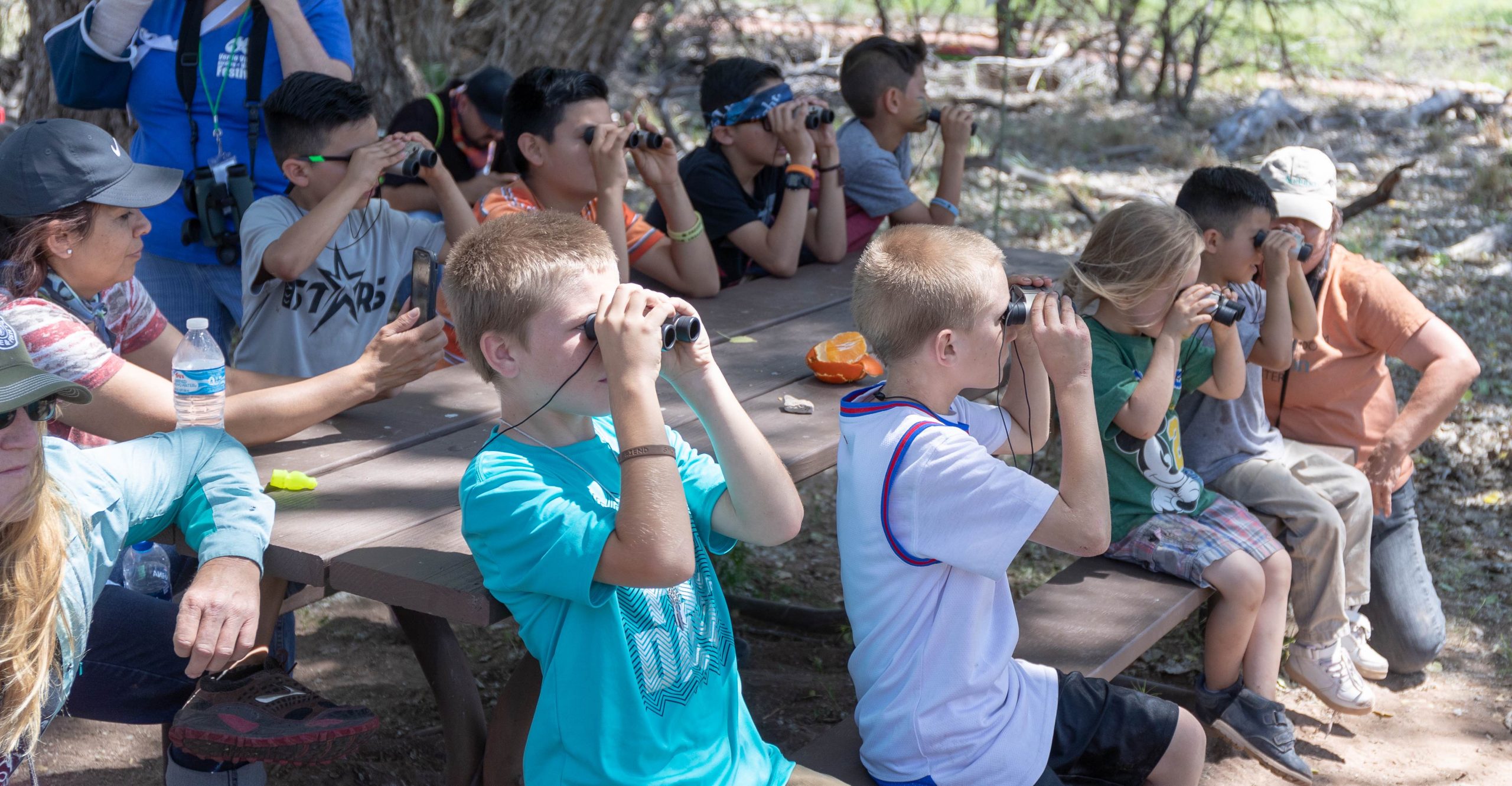
A dozen people sat around a picnic table. Surrounding them was an amphitheater of bird feeders — houses full of seed, hanging socks with grains and water. Every few seconds, another of the enthusiastic birdwatchers would reach to the binoculars around their necks or the DSLR camera’s with huge zooms attached.
“These are Lesser Goldfinches,” Rich Armstrong, of the Northern Arizona Audubon Society, told the assembled birders. He pointed at a group of birds with blindingly yellow feathers across their fronts, before gesturing at another. “There’s a Chipping Sparrow next to feeder 8.”
All around the bird feeders, a flock of Lazuli Buntings flitted about. Their backs and heads featured a bright blue plumage, evoking the precious stone of their namesake, while their breasts featured a deep orange that popped out against not just the blue, but also the green of the foliage in Dead Horse Ranch State Park.
“I need to see a Siskin, so will you tell him to come over?” one of the assembled birdwatchers joked to Armstrong.
Armstrong led a brief workshop on Armchair Birding, one of the dozens of opportunities to see flying critters at the Verde Valley Birding & Nature Festival. From Thursday, April 25, through Sunday, April 28, hundreds of bird enthusiasts descended on Cottonwood and the surrounding area to take advantage of the spring migration of hundreds of bird species north from Mexico. The festival workers led field trips bright and early in the morning to special spots where birds could be found — they went up Mingus Mountain and Sycamore Canyon, where they sought vultures and hummingbirds, woodpeckers and hawks. On Saturday afternoon, Armstrong led an expedition to a house in Clarkdale where a Golden Crowned Sparrow, which had not been sighted in the Verde Valley for four years, had been reportedly spotted.

Ornithologists came from far and wide to the Verde Valley for the festival. Jim Sandor of Monterey, Calif., spent a week birding in Arizona, visiting the southeastern region of the state first. He was happy to see a Common Blackhawk, which is only common in the Verde Valley. Kate Pitts and Ron Brown, two employees at Grand Canyon National Park, came down.
“I come here as often as I can, for the birds. This whole area is good for spring birding,” Brown said. “People always ask me what my favorite bird is, and it’s whatever I’m looking at.”
Pitts spoke highly not just of the opportunity to see birds in the wild, but to learn about them as well. She said her favorite part was Friday evening’s keynote speaker, Dr. John Marzluff of the University of Washington. Marzluff’s speech focused on the opportunity to see birds not just in the wilderness, but in what he refers to as “subirdia,” the human settlements that certain birds have adapted to and thrived in. He included tips on how to make a neighborhood more bird- friendly, ranging from bird feeders to the advice to stop mowing your lawn and allow for native vegetation to thrive.
“Learning how to look at birds in my backyard and find bigger stories about evolution and climate change — it’s really something,” Pitts said.
For Marzluff, speaking at the birding festival was an opportunity to return to an area where he had in his youth spent many hours birdwatching. He got his doctorate in ornithology at Northern Arizona University and relished the chance to again see the bird variety of Northern Arizona.
“We love the area and it was great to come back and see some familiar birds,” Marzluff said. “It’s south, so it’s close to Mexico. You get species that cross the border and her you’ve got the river and the desert scrub, with the Ponderosa pines up near Flagstaff. You’ve got a lot of different habitats close together.”
In addition to all the activities for accomplished birders, the festival featured an opportunity to bring the next generation into the hobby as well. The festival gave two scholarships to youngsters from the area — Quincy Mabery of Cottonwood and Danae Dearden of Cornville, both 10 years old — in order for them to attend birding camp this summer.
Mabery has been interested in birds “since forever” and holds special fascination for birds of prey, especially his favorite bird, the peregrine falcon, the fastest animal in the world.
“I think they’re cool,” Mabery said. “They’re pretty looking and they just fascinate me.” Mabery eagerly spoke of the bald eagle that lives near his house.
“If it spread its wings, it would probably be as big as her,” he said, gesturing at his little sister.
“I’ve been a bird for almost every Halloween,” Dearden said, also mentioning she had loved birds “forever.” This year, she hopes to dress up as a Blue Macaw, a stunning parrot from South America. But her favorite bird is the Harpy Eagle, an enormous bird from Central and South America.
“They are one of the biggest birds,” Dearden said. “Their talons are as big as a grizzly bear’s claws and they can take off with monkeys in them.”


